
















There is nothing particularly unusual about Mount Etna flinging lava, volcanic ash, or molten rocks into the air. The Italian volcano ranks as one the most active in Europe and has been in a state of eruption since 2011.
Yet even experienced Etna watchers have been wowed by the intensity of the volcano’s unrest in February 2021. Starting on February 16, Etna’s Southeast Crater produced a string of intense lava fountains that continued sporadically for nearly a week. Southeast Crater is one of four summit craters on the volcano and the youngest; it formed in 1971.
“The most recent novelty is that the last six eruptive paroxysms were among the most violent in the Southeast Crater's young history,” explained Marco Neri, a volcanologist with Italy's National Institute of Geophysics and Volcanology (INGV).
February 20-21 and February 22-23 brought particularly intense activity. At times, lava fountains soared as high as 1.5 kilometers (0.9 miles), about 3 times the height of One World Trade Center, the tallest building in the United States. Columns of ash and small rock fragments (called lapilli) rose as high 10 kilometers (6 miles) in altitude. Long lava flows poured down Etna's eastern flank.
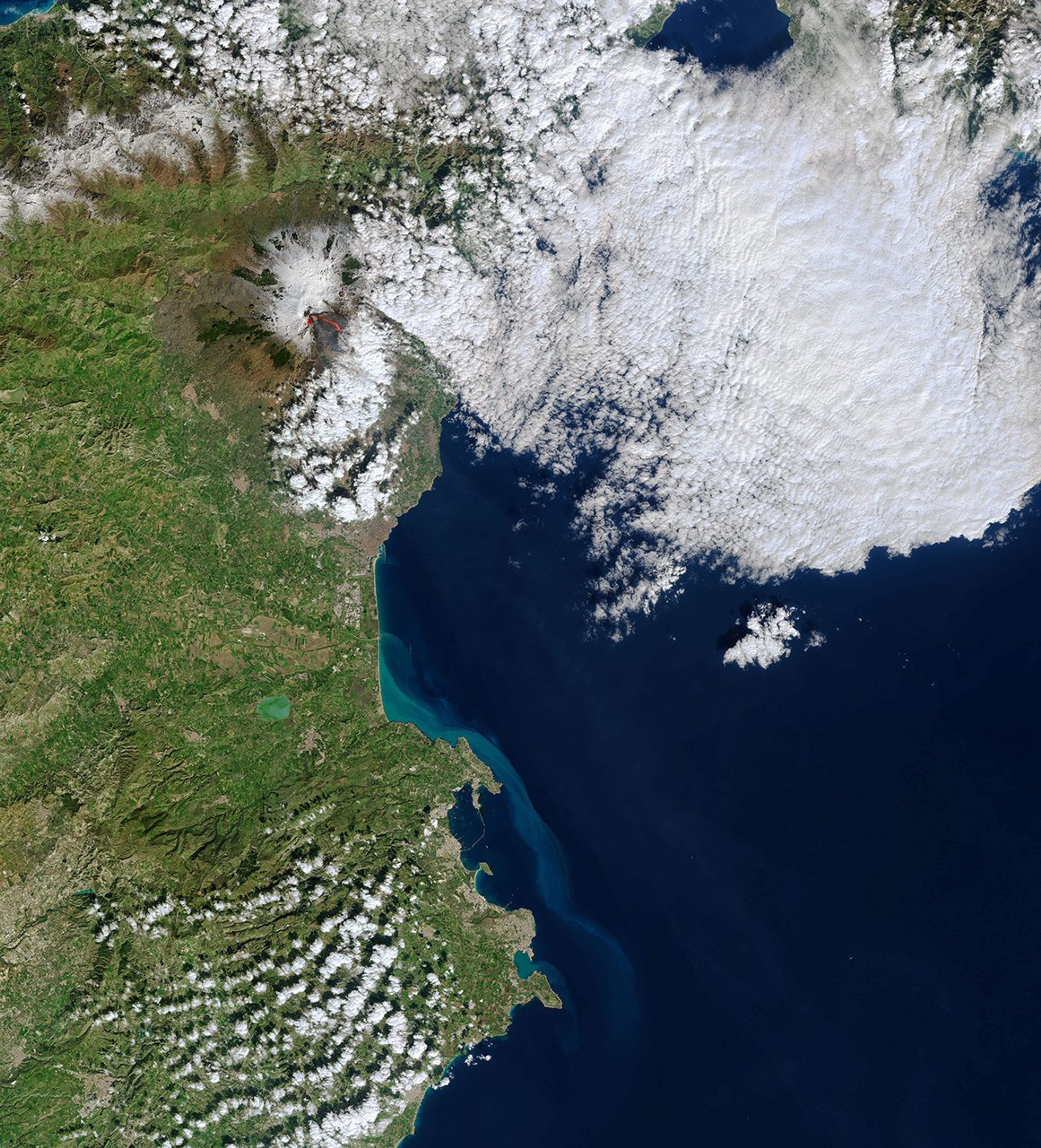
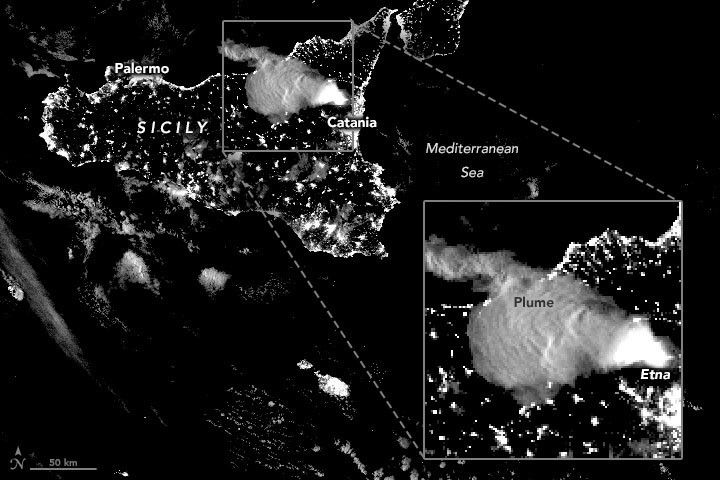
At 1:37 a.m. local time (00:37 Universal Time) on February 23, 2021, the Visible Infrared Imaging Radiometer Suite (VIIRS) on the NOAA-20 satellite captured an image (above) showing one of several volcanic plumes Etna has produced recently. At the time, the partially illuminated plume was spreading northwest across Sicily. It deposited a layer of ash in Palermo before heading north toward Sardinia.
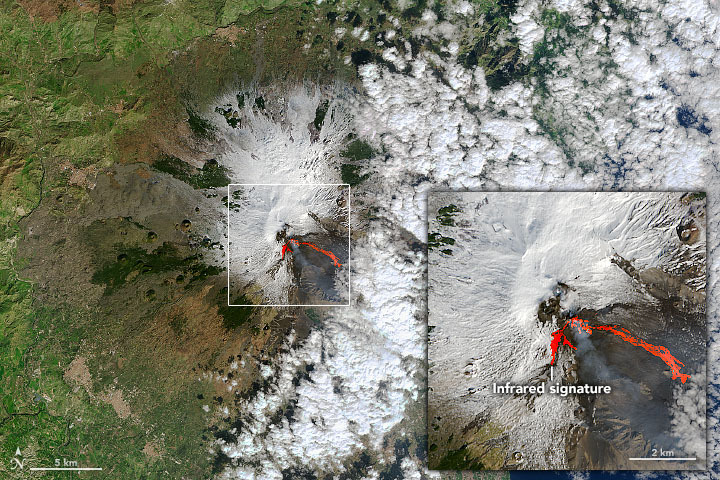
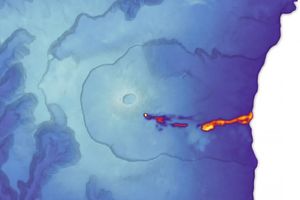
On February 18, 2021, the Operational Land Imager (OLI) on Landsat 8 acquired the second image, a natural-color view (OLI bands 4-3-2) of the volcano. At the time, lava from Southeast Crater was flowing southward and eastward from the summit. The natural-color image is overlaid with infrared data from OLI showing the location of warm areas associated with lava.
While the recent paroxysms have impressed geologists, they were not out of character for the restive volcano. Paroxysms of similar intensity have occurred at Mount Etna at least four times since 1989, and the volcano has produced roughly 250 paroxysms of various strengths since 1977, said Boris Behncke, also with INGV.
While ash temporarily closed the nearby airport and meant extra sweeping for many people in northern Sicily, the February paroxysms caused little serious damage or disruption. As long as the paroxysms remain at this intensity and lava comes from the summit rather than the sides of the volcano, the risks poses to surrounding communities are small.
But there is no guarantee that Etna will remain in its current eruptive stance forever. “Periods of intense activity are almost always followed by lateral eruptions that open up mouths on the flank of the volcano, at times at low elevations,” said Neri. “That means there is a concrete possibility that lava could directly affect an urbanized area, as has happened numerous times in the past.”
Lava from Etna has occasionally caused problems for surrounding communities. In 1669, lava overwhelmed part of Catania. In 1983, engineers used dynamite to divert lava away from homes. And in 1992, the army had to build an earthen wall to protect a village.
References & Resources
- Associated Press (2021, February 23) Mt Etnaâs latest eruptions awe even those who study volcanos. Accessed February 25, 2021.
- Discover (2021, February 24) Lava fountains about as Etna starts 2021 in spectacular fashion. Accessed February 25, 2021.
- INGV (2021) Etna. Accessed February 25, 2021.
- NASA Earth Observatory Activity at Mount Etna. Accessed February 25, 2021.
- Smithsonian Institution, Global Volcanism Program (2021) Etna. Accessed February 25, 2021.
- The Guardian (2021, February 23) Mount Etna illuminates night sky with 1,500-metre lava fountain. Accessed February 25, 2021.
- The Washington Post (1983) Etna renews its angry struggle with man. Accessed February 25, 2021.
- Volcano Discovery (2021) Etna volcano - eruption update. Accessed February 25, 2021.
NASA Earth Observatory image by Joshua Stevens, using VIIRS day-night band data from the Joint Polar Satellite System and Landsat data from the U.S. Geological Survey. Story by Adam Voiland.