
















It is the “rain” in the term “rainforest” that makes possible the diverse ecosystem teeming with plants and animals. That doesn’t mean a rainforest is always wet: tropical rainforests are known for having distinct wet and dry seasons. But new research shows that the summer dry season in the Congolese rainforest of central Africa is growing longer.
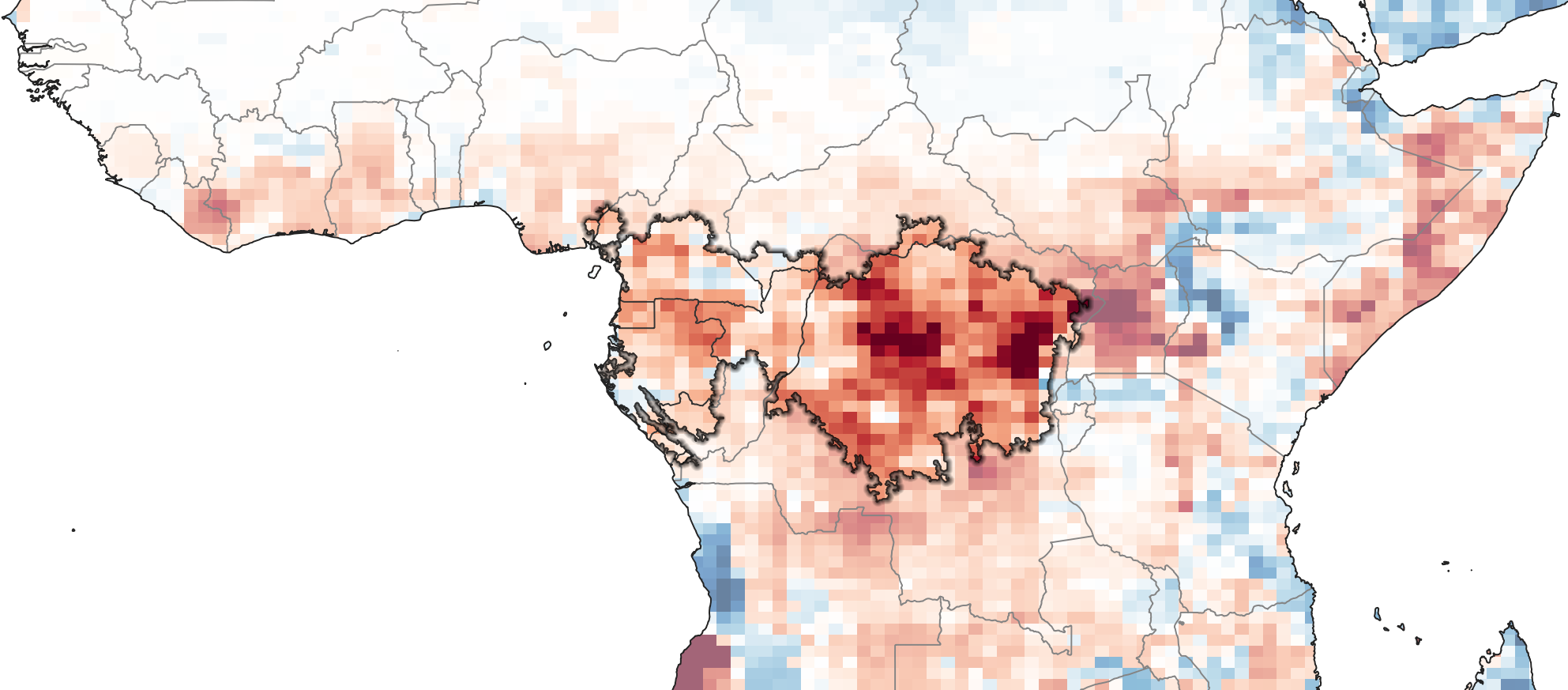
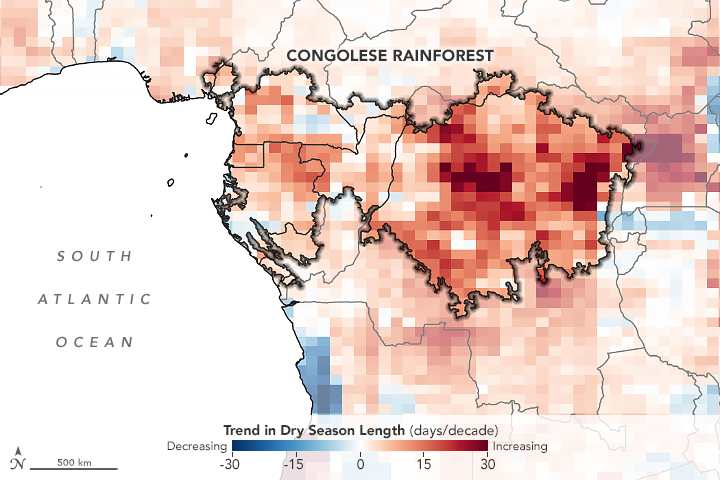
The widespread lengthening of the dry season is visible in this map, which shows the number of days per decade by which the dry season has grown longer (red) or shorter (blue) between 1980 and 2015. It is based on analysis of NASA’s MERRA-2 precipitation dataset of the Global Modeling and Assimilation Office (GMAO). Within the rainforest boundaries the dry season has lengthened by about 10 days per decade. Similar changes were also observed in other precipitation and satellite-based vegetation datasets.
The Congo rainforest’s dry season is seeing changes at both ends of the boreal summer from June through August. Droughts between April and June are causing the dry season to start sooner. And without a replenishment of soil moisture, the dry season is ending later, which postpones the start of the next wet season and hinders vegetation regrowth.
“Dry season length is one of the most crucial climate limitations for sustaining rainforest,” said Liming Zhou, an atmospheric scientist at University at Albany and co-author of the paper. “It strongly influences tropical rainforest vegetation structure and composition. Any large changes that modify the rainforest’s dry season length and intensity can potentially influence the tropical rainforest’s photosynthesis and productivity.”
Zhou noted that if the dry season continues to lengthen, the Congo’s current vegetation could be replaced by species that are more tolerant of drought. For instance, evergreen forests could transition into savannas or woody grasslands—ecosystems that favor drier conditions.
Such a transition would further accelerate climate change, Zhou said. That’s because vegetation in the Congo—the second-largest rainforest in the world—is an important carbon sink. Lose that rainforest area and you lose vegetation that is important for absorbing carbon dioxide from the atmosphere.
According to Yan Jiang, a graduate student at University at Albany and the study’s lead author, longer dry seasons have also been observed in the Amazon Basin—home to the largest tropical rainforest on Earth. By comparison, the Congo rainforest is, on average, much drier than the tropical rainforests in South America and Southeast Asia. That likely makes the Congo that much more water-limited during the dry season and even more sensitive to changes in rainfall patterns.
References & Resources
- Jiang, Y. et al. (2019) Widespread increase of boreal summer dry season length over the Congo rainforest. Nature Climate Change.
- NASA News (2014, April 23) NASA Satellites Show Drought May Take Toll on Congo Rainforest.
- University at Albany (2019, June 28) Study: Longer Summer Dry Season Observed in Congo Rainforest. Accessed July 1, 2019.
NASA Earth Observatory image by Joshua Stevens, using data courtesy of Jiang, Y., et al. (2019). Story by Kathryn Hansen.