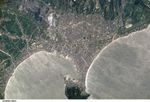

























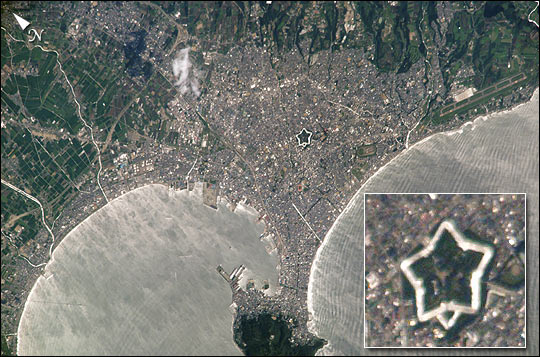
This photograph taken from the window of the International Space Station on August 22, 2002 shows Hakodate City, Japan (population 288,491). Hakodate City is a seaport located on two bays in the Oshima Peninsula near the south end of the major Japanese island of Hokkaido. This image nicely illustrates how sunglint reflecting off the ocean reveals internal waves impinging on the coast. Also, from space, Hakodate is quite distinguished from other cities of it size, featuring a large five-pointed star near it center.
The star known as “Goryokaku” is actually the first Western-style fort built in Japan from 1857-64. Today the historic fort is a 251,400 square meter (62 acre) park (note the green center), well known for its majestic cherry blossoms. It is also now a major tourist attraction. In the hundred feet wide outer moat (higlighted by sunglint) large, colorful Japanese Carp and boat rentals are popular attractions.
For more information on the Goryokaku Fort see the Japan Atlas.
References & Resources
Astronaut photograph ISS005-E-10643 was provided by the Earth Sciences and Image Analysis Laboratory at Johnson Space Center. Additional images taken by astronauts and cosmonauts can be viewed at the NASA-JSC Gateway to Astronaut Photography of Earth.