




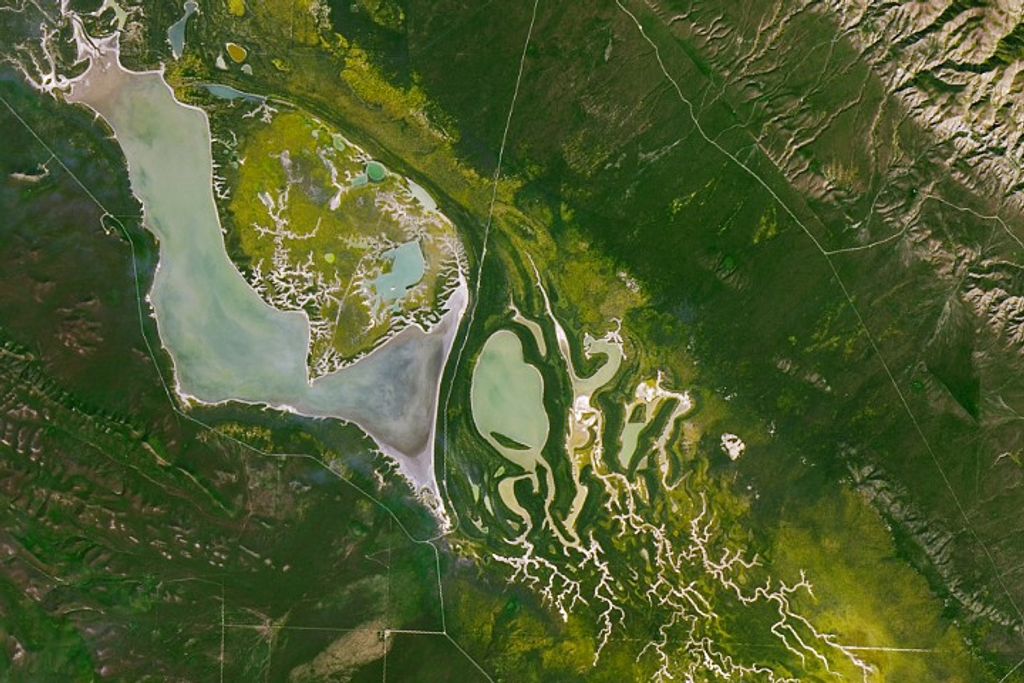













Once home to the powerful Inca Empire, the spectacular vistas andcanyons of the South American Andes are now a favorite to mountainbikers, climbers and other tourists looking for an adventure. This truecolor image of the Central Andes and surrounding landscape was acquiredby the Moderate-resolution Imaging Spectroradiometer (MODIS), flyingaboard NASA’s Terra spacecraft. The dark green area to the right of thebrown mountains are the Gran Chaco planes, which consist mostly ofalluvial fans and wetlands. To the west is the Pacific Ocean.
In the upper half of this image, the Andes are formed by two distinctmountain ranges that appear as darker reddish-brown bands runningnorthwest to southeast. Between the two ranges, shown in a lighterbrown, sits the Altiplano plateau, which spans southern Peru andnorthern Bolivia. The plateau sits at 3660 meters (12,000 feet) and is covered inmazelike canyons, marshlands and lakes. The largest of the lakes—LakeTitticaca—can be seen as the dark blue patch in southern Peru. The twomountain ranges supporting the plateau eventually come together alongthe border of Argentina and Chile to form one continuous range.
The Andes have been forming over the past 170 million years as the NazcaPlate lying under the Pacific Ocean has forced its way under the SouthAmerican Plate and pushed up its western edge. The subduction of oneplate under the other has given rise to a number of volcanoes that dotthe western edge of the mountain range. Earthquakes are also very commonin this region.
References & Resources
Image by NASA GSFC, based on data from the MODIS science team.