















About 600 million years ago, during the Ediacaran Period, Earth was a vastly different place. The land, having recently shed a global blanket of slushy ice, was mostly barren and lifeless. However, an array of bizarre, soft-bodied creatures thrived in shallow seas, including worm-like organisms with crescent heads, spiral-shaped mounds with unusual trilateral symmetry, and fern-like fronds that grew several feet tall.
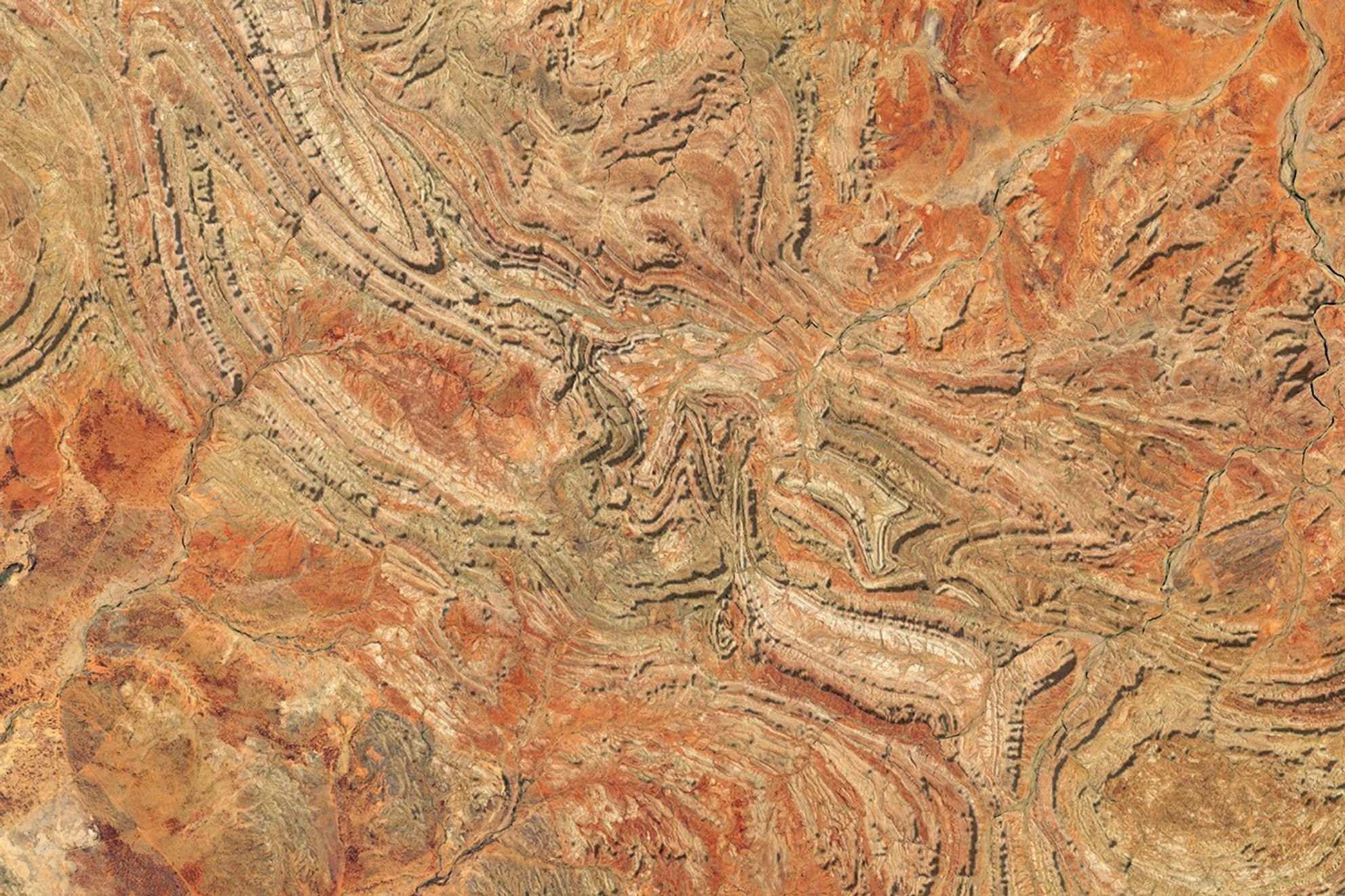
Creatures like these may have been obliterated when an asteroid, thought to be roughly 200-400 meters (700-1300 feet) across, blazed through the sky and smashed into land or shallow waters around what is now the Davenport Range of northern Australia. While much of the original impact crater has eroded, telltale signs of the collision remain imprinted on the folded sedimentary and volcanic rock layers.
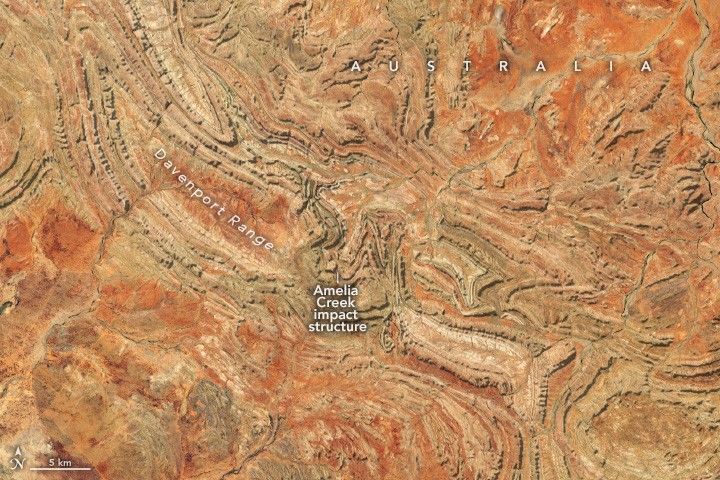
On February 3, 2025, the Operational Land Imager (OLI) on Landsat 8 captured this view of the impact site, an area called the Amelia Creek impact structure. The collision gouged a canoe-shaped trough about 1 kilometer wide and 5 kilometers long. An analysis of satellite observations shows deformation in the regional rock strata extends about 10 kilometers north and south of the impact crater, with minimal deformation to the east and west.
The long, narrow shape of the crater and the pattern of regional deformation are signs that the asteroid struck at an extremely oblique (shallow) angle. A steeper-angle asteroid impact—such as the one that doomed the dinosaurs—would have left a deeper, more symmetrical crater and created an elevated feature in the center of the crater known as a central uplift.
Other telltale clues of an impact event at Amelia Creek are buried in nearby quartzite rock strata. Starting in the 1980s, geologists discovered fan-shaped fractures, later identified as
—rare geologic features that only form when impact events send shock waves barreling through rock. All of the area’s shatter cones are distributed in a crescent-like pattern mainly to the south of the crater, another sign that the asteroid struck at a shallow angle.
The amount of damage caused by the impact is unclear, but asteroids that hit Earth at shallow angles are thought to cause less damage than those that strike at steep angles. The shallow angle means the rocky body passes through Earth’s atmosphere for a longer distance, burning off more mass and often breaking into smaller pieces before impact.
While the most severe damage was probably localized near the site of the collision, geologists have
suggesting that two other larger impacts during the Ediacaran may have had much greater and even global effects, possibly contributing to the extinction of an enigmatic class of creatures called
and helping cause global changes in ocean chemistry and climate.
References & Resources
- Amelia Creek, Northern Territory (2003) Amelia Creek, Northern Territory. Accessed March 18, 2025.
- The Burgess Shale Enigmatic Ediacarans. Accessed March 18, 2025.
- City College of San Francisco Ediacaran Garden. Accessed March 18, 2025.
- Haines, P. (2005) Impact cratering and distal ejecta: the Australian record. Australian Journal of Earth Sciences, 52, 4-5.
- Impact Earth Amelia Creek - Hypervelocity Impact Crater. Accessed March 18, 2025.
- Live Science (2016, January 12) Images: Bizarre, Primordial Sea Creatures Dominated the Ediacaran Era. Accessed March 18, 2025.
- Macdonald, F., et al. (2004) Amelia Creek: a Proterozoic impact structure in the Davenport Ranges, Northern Territory. Australian Journal of Earth Sciences, 52, 4-5.
- NASA Asteroid Facts. Accessed March 18, 2025.
- NASA (2015) “Snowball Earth” Might Have Been Slushy. Accessed March 18, 2025.
- Osinski, G., et al. (2022) Impact Earth: A review of the terrestrial impact record. Earth-Science Reviews, 232, 104112.
- The Planetary and Space Science Centre (2007) Amelia Creek. Accessed March 18, 2025.
- Space.com (2022, September 26) Asteroid apocalypse: How big must a space rock be to end human civilization? Accessed March 18, 2025.
- Staffieri, S., (2019) et al. Amelia Creek, Australia. Encyclopedic Atlas of Terrestrial Impact Craters, 225-227.
- Young, G. (2015) Environmental upheavals of the Ediacaran period and the Cambrian “explosion” of animal life. Geoscience Frontiers, 6(4), 523-535.
NASA Earth Observatory image by Wanmei Liang, using Landsat data from the U.S. Geological Survey and using topographic data from the Shuttle Radar Topography Mission (SRTM). Story by Adam Voiland .