


















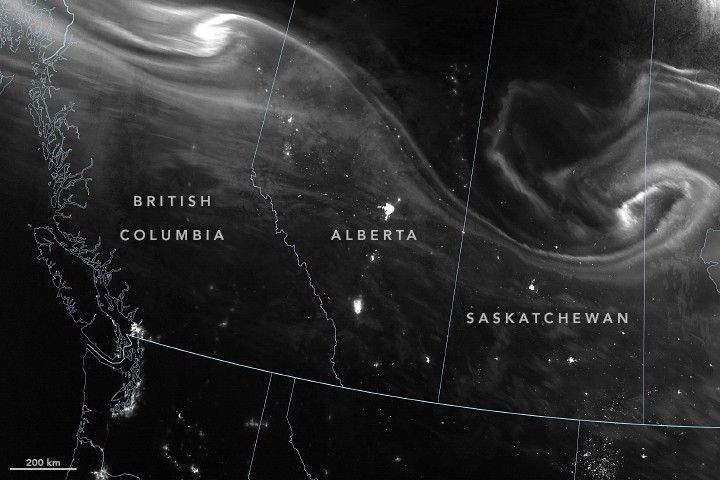
In late-April 2023, a severe geomagnetic storm in Earth’s magnetosphere led to an especially vivid display of the aurora. During the peak of the event, colorful lights illuminated skies well beyond the polar regions, where the atmospheric phenomenon is most common. As the northern lights lit up skies in places as far south as Arizona and Arkansas in the United States, so did social media and news sites with dazzling photographs of rays, sheets, and curtains of color dancing in the night sky.
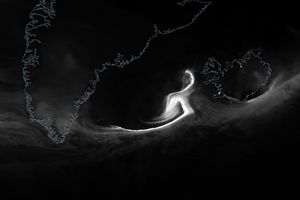
The far-reaching light show was impressive when viewed from above as well—even in black and white satellite imagery. The Visible Infrared Imaging Radiometer Suite (VIIRS) on the NOAA-NASA Suomi NPP satellite captured this image of light from the aurora over western Canada and dipping into parts of the United States at 2:15 a.m. local time (06:15 Universal Time) on April 24, 2023. VIIRS has a day-night band that detects nighttime light in a range of wavelengths from green to near-infrared and uses filtering techniques to observe signals such as city lights, reflected moonlight, and auroras.
The same sensor observed bright bands of light spanning northern Russia and illuminating Antarctica and the Southern Ocean on the same night. Impressive displays of the southern lights turned up in parts of Australia and New Zealand.
“The amazing displays of aurora dancing across the sky are the result of the complex interactions between the solar wind and the magnetosphere,” explained NASA space physicist Elizabeth MacDonald in an article for The Conversation. “[They] are caused by charged particles from Earth’s magnetosphere and the solar wind colliding with other particles in Earth’s upper atmosphere. Those collisions excite the atmospheric particles, which then release light as they “relax” back to their unexcited state.”
The creation of an aurora typically starts when the Sun sends a surge of its charged particles—through solar flares, coronal mass ejections, or an active solar wind—toward Earth. In this case, the aurora was caused by a coronal mass ejection—a large expulsion of plasma and magnetic field lines from the Sun—on April 21, 2023, according to the NOAA Space Weather Prediction Center. The coronal mass ejection created a “severe” geomagnetic storm, classified as a G4 storm, in Earth’s magnetosphere on April 23. Storms of this strength typically occur about 100 times over an eleven-year solar cycle.
References & Resources
- The Conversation (2023, March 29) What are auroras, and why do they come in different shapes and colours? Two experts explain. Accessed April 25, 2023.
- NASA Solar Storm and Space Weather - Frequently Asked Questions. Accessed April 25, 2023.
- NOAA Space Weather Prediction Center (2023, April 24) Weekly Highlights. Accessed April 25, 2023.
- NOAA Space Weather Prediction Center (2023, April 24) News Archive. Accessed April 25, 2023.
- NASA Earth Observatory (2012, December 5) Out of the Blue and Into the Black. Accessed April 25, 2023.
- NASA Be a Citizen Scientist With the ‘Aurorasaurus’ Project. Accessed April 25, 2023.
- NASA Aurora: Illuminating the Sun-Earth Connection. Accessed April 25, 2023.
- The Washington Post (2023, April 24) Southern and northern lights sweep planet in stunning display of auroras. Accessed April 25, 2023.
NASA Earth Observatory image by Lauren Dauphin, using VIIRS day-night band data from the Suomi National Polar-orbiting Partnership . Story by Adam Voiland .