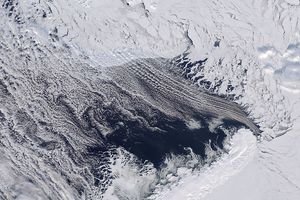



















Antarctic sea ice reached its lowest maximum extent on record on Sept. 10 at a time when the ice cover should have been growing at a much faster pace during the darkest and coldest months.
Sea ice around Antarctica reached its lowest winter maximum extent on September 10, 2023, at 6.5 million square miles (16.96 million square kilometers), according to researchers at NASA and the National Snow and Ice Data Center (NSIDC). That’s 398,000 square miles (1.03 million square kilometers) below the previous record-low reached in 1986—a difference that equates to roughly the size of Texas and California combined. The average maximum extent between 1981 and 2010 was 7.22 million square miles (18.71 million square kilometers).
The map at the top of this page shows the sea ice extent on September 10, 2023. “It’s a record-smashing sea ice low in the Antarctic,” said Walt Meier, a sea ice scientist at NSIDC. “Sea ice growth appears low around nearly the whole continent as opposed to any one region.”
Scientists are working to understand the cause of the meager growth of the Antarctic sea ice, which could include a combination of factors such as El Niño, wind patterns, and warming ocean temperatures. New research has shown that ocean heat is likely playing an important role in slowing cold season ice growth and enhancing warm season melting.
This record-low extent so far in 2023 is a continuation of a downward trend in Antarctic sea ice that started after a record high in 2014. Prior to 2014, ice surrounding the continent was increasing slightly by about 1% per decade.
Sea ice melting at both poles reinforces warming because of a cycle called “ice-albedo feedback.” While bright sea ice reflects most of the Sun’s energy back to space, open ocean water absorbs 90% of it. With greater areas of the ocean exposed to solar energy, more heat can be absorbed, which warms the ocean waters and further delays sea ice growth.
Editor’s note: An update on Arctic sea ice is here.
References & Resources
- NASA Earth Observatory (2021, January 6) Sea Ice. Accessed September 26, 2023.
- NASA Scientific Visualization Studio (2023, September 25) Antarctic Sea Ice Maximum, 2023. Accessed September 26, 2023.
- NASA’s Earth Science News Team (2022, September 25) Antarctic Sees Record Low Growth. Accessed September 26, 2023.
- NSIDC (2023, September 25) Antarctic sea ice hits record low maximum extent for 2023. Accessed September 26, 2023.
- NSIDC (2023, September 25) Antarctic sets a record low maximum by wide margin. Accessed September 26, 2023.
NASA Earth Observatory images by Lauren Dauphin, using data from the National Snow and Ice Data Center . Story by Sally Younger (NASA’s Earth Science News Team).