














The eruption at Chile’s Puyehue-Cordón Caulle Volcanic Complex sent clouds of ash high into the atmosphere, above the weather that usually breaks up such plumes. The CALIPSO satellite recorded the plume 15 kilometers (50,000 feet) above the Earth on the second day of the eruption, and the volcano continues to push ash into the atmosphere. At these high altitudes, the ash entered the jetstream and blew quickly eastward.
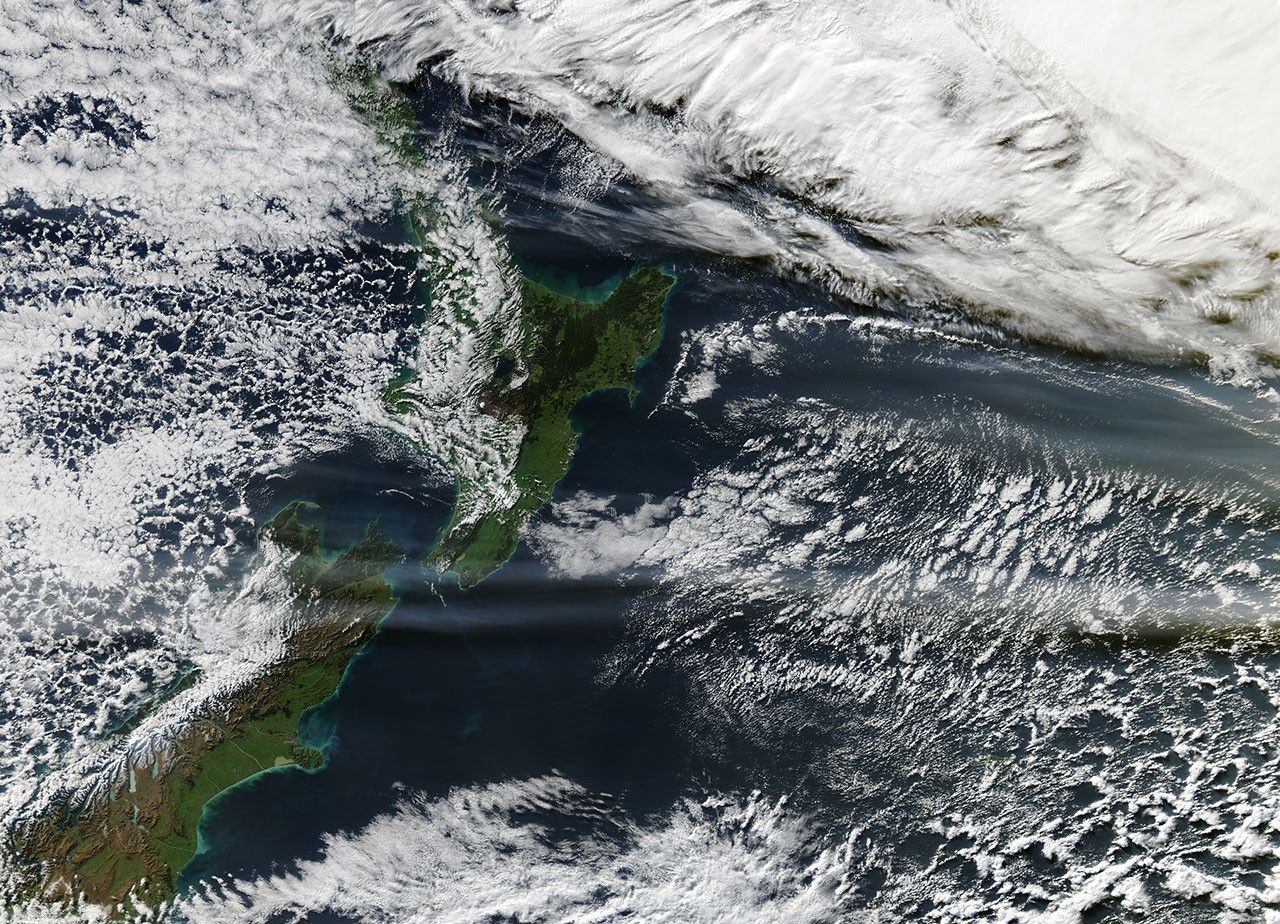
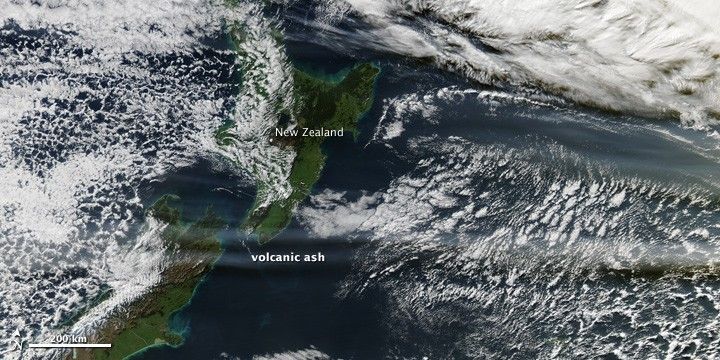
By June 13, when the Moderate Resolution Imaging Spectroradiometer (MODIS) on the Aqua satellite acquired these images, a concentrated plume was visible more than half a world away over Australia and New Zealand. The top image shows the ash plume over southern Australia and the Tasman Sea, while the lower image provides a view farther east over New Zealand and the South Pacific Ocean.
The Civil Aviation Authority of New Zealand warned pilots that the ash cloud was between 20,000 and 35,000 feet (6 to 11 kilometers), the cruising level for many aircraft. Because volcanic ash can damage a jet engine, flight traffic in parts of Australia and New Zealand was canceled or diverted to lower altitudes.
References & Resources
- Australian Broadcasting Corporation News. (2011, June 13). More delays ahead as ash cloud circles. Accessed June 13, 2011.
- Civil Aviation Authority of New Zealand. (2011, June 11). Ash cloud from Chilean volcano entering New Zealand Airspace. Accessed June 13, 2011.
NASA images ( New Zealand and Australia ) courtesy Jeff Schmaltz, MODIS Rapid Response Team at NASA GSFC. Caption by Holli Riebeek.