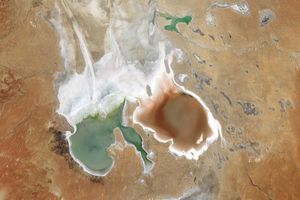















The green-brown waters of Barkol Lake sit within the pale shorelines of an ancient lake, hinting that the climate was once much wetter in this part of western China. Today the region is arid and brown. Barkol Lake’s annual mean precipitation is 210 millimeters (8 inches), while the annual evaporation rate is 2,250 millimeters (89 inches). The desert lake receives most of its water from runoff, and the water that remains after evaporation is very salty and full of minerals. Square ponds on the edge of the lake are probably evaporation ponds used to extract those minerals from the water.
Astronauts on the International Space Station snapped this photo on the lake on November 6, 2013. The astronauts were looking over the lake from the west, so east is toward the top of the photograph. The basin is closed, which means that the small streams in the photo run into the lake, but nothing runs out. Evaporation is the only means through which water leaves Lake Barkol.
The ancient shorelines show up as concentric rings, indicating that water levels have varied many times. One study identified five climates at Barkol Lake over the past 8,000 years, ranging from warm and wet to cold and wet and finally cold and dry. The average annual temperature in the area is now just 1° Celsius (34° F), though temperatures swing from extreme highs (33.5° C or 92.3° F) to extreme lows (-43.6° C or -46.5° F).
References & Resources
- Xue. J. and Zhong, W. (2010, December 8) Holocene climate variation denoted by Barkol Lake sediments in northeastern Xinjiang and its possible linkage to the high and low latitude climates. Science China Earth Sciences. Accessed June 20, 2014.
Astronaut photograph ISS037-E-27704, NASA Johnson Space Center Earth Observation Laboratory. Caption by Holli Riebeek, with information provided by Yongwei Sheng.