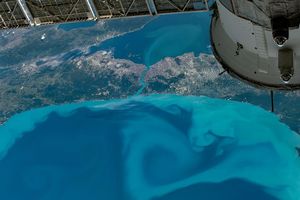





























A break in the clouds provided a window to a brilliant display of color in the Barents Sea north off Norway on August 1, 2007. The bright aquamarine hues suggest that this is likely a coccolithophore bloom. A coccolithophore is a tiny, surface-dwelling ocean plant that is coated with microscopic limestone (calcite) scales. This white coating makes the plant highly reflective. It reflects nearly all of the light that hits it, and it is this reflected light that gives the ocean the radiant blue color seen in this image.
Coccolithophores flourish in nutrient-poor, sub-polar waters. Like other types of microscopic ocean plants (phytoplankton), coccolithophores are an important food source for fish and other marine animals. Coccolithophore blooms occur when large numbers of the plants grow in one place. Such blooms can be large: The visible portion of this bloom covers about 150,000 square kilometers (57,000 square miles) or roughly the area of Wisconsin. The Moderate Resolution Imaging Spectroradiometer (MODIS) on NASA’s Terra satellite captured this image.
References & Resources
NASA image courtesy Norman Kuring, Ocean Color Group at Goddard Space Flight Center.