


















May 30, 1984-May 31, 2025
Breaking New Ground in Mekele
Since 1980, Africa’s population has tripled to 1.5 billion people, representing faster growth than any other continent. The trend will likely continue. While many countries around the world are experiencing stagnant or declining populations, most African nations are expected to grow rapidly in the coming decades.
By some estimates, Africa’s population will swell to 2.5 billion people by 2050, with more than 80 percent of the increase concentrated in cities, said Jody Vogeler, a Colorado State University researcher whose lab is using satellites to study urbanization trends in Africa. The continent’s fast-growing cities are expected to bring huge changes, including a possible 12-fold increase in urban land area by 2030.
Vogeler and other urbanization experts expect to see some of Africa’s fastest growth rates in what they describe as “secondary cities”—those that are larger than 100,000 people and regionally important but not the largest in a country. This is often accompanied by unplanned settlements—areas where the population is growing faster than the city can provide infrastructure and services like roads, water, sanitation, schools, and electricity.
“Africa really is the last frontier for urbanization,” Vogeler said. “It’s often in secondary cities where we see the increase in the spatial extent of cities far outpacing population growth.”
Vogeler and her collaborators aim to bring more attention to secondary cities in Africa and to generate data products useful to city governments and urban planners. To achieve this, they are working on a project that taps into remote sensing data to generate annual land-cover maps for cities in pilot countries, including Ethiopia, Nigeria, and South Africa. Among them is Mekele, one of Ethiopia’s fastest-growing secondary cities. Located in the highlands of northern Ethiopia in the Tigray region, it sits amid a tapestry of sedimentary rock formations that have been sculpted into a landscape of layered ridges, steep cliffs, and flat-topped mountains.
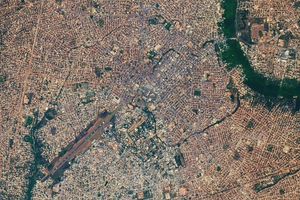
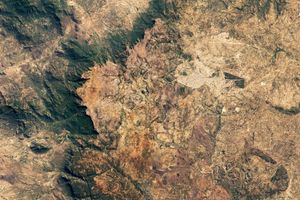
Historically, Ethiopia has been one of Africa’s least urbanized countries. But in recent decades, urbanization has accelerated, with many Ethiopians moving from rural areas to rapidly growing towns and small cities. The pair of Landsat images above, acquired in 1984 (left) and 2025 (right), show Mekele’s transformation from a town of 60,000 people to a city of more than 500,000, complete with heavy industry, an airport, a cement plant, and large-scale planned residential neighborhoods.
In recent decades, planned development has appeared in the form of large, regularly spaced buildings in grid patterns around straight roads on rectangular blocks. These developments have generally spread to the south, southeast, west, and northeast of the historical heart of the city. In addition, many informal, unplanned settlements with smaller buildings set on irregularly shaped blocks have sprung up around the planned settlements, especially on the outskirts of the city.
According to one analysis, unplanned settlements make up about 13 percent of the city. One of the things Vogeler is most proud of is the lab’s development of a new automated technique for delineating the boundary of the city that goes beyond the simple administrative boundary to include clusters of development—both planned and unplanned—that are functionally part of the city but have been excluded in the past.
“City planners and other stakeholders can miss a lot of areas that are really integral to cities by simply using the official administrative boundaries,” Vogeler said. “Urban growth can bring many positive services to cities, such as jobs and economic growth, but when it happens too rapidly, there can be a real lag in infrastructure and investment that can lead to tremendous suffering.”
The lab has also developed a series of land cover maps for Mekele and other cities in Ethiopia, Nigeria, and South Africa that are designed to make it easier for city managers, urban planners, and researchers to understand how these cities are changing over time. According to Vogeler, the land cover maps are tailor-made to support specific sustainable development goals established by the United Nations.
References & Resources
- Cardenas-Ritzert, O. S. E., et al. (2025) Urban land cover maps for Mekelle, Ethiopia and Polokwane, South Africa, 2020. ORNL DAAC. Accessed September 5, 2025.
- Cardenas-Ritzert, O. S. E., et al. (2024) Automated geospatial approach for assessing SDG Indicator 11.3.1: a multi-level evaluation of urban land use expansion across Africa. ISPRS International Journal of Geo-Information, 13(7), 226.
- Cardenas-Ritzert, O. S. E., et al. (2024) Effects of land use data spatial resolution on SDG Indicator 11.3.1 (urban expansion) assessments: a case study across Ethiopia. Sustainability, 16(22), 9698.
- German Institute for International and Security Affairs (2023, June 18) Growth beyond the capital: Understanding Africa’s secondary cities. Accessed September 5, 2025.
- Heydari, S.S., et al. (2024) Multi-tier land use and land cover mapping framework and its application in urbanization analysis in three African countries. Remote Sensing, 16(14), 2677.
- Laituri, M., et al. (2025) The last urban frontier—assessing hotspots of urban change associated with LCLUC in Africa. Frontiers in Sustainable Cities, 7, 1529440.
- Macrotrends (2025) Africa population (1950-2025). Accessed September 5, 2025.
- NASA (2022) ARSET – Earth Observations Toolkit for Sustainable Cities and Human Settlements. Accessed September 5, 2025.
- Negese, D. S. (2020) Case study overall assessment and mapping of informal settlement in Mekelle City. Accessed September 5, 2025.
- NYU Marron Institute (2024, January 31) The success of urban expansion planning. Accessed September 5, 2025.
- Our World in Data (2024, November 28) The UN projects that Africa’s population will double by 2070. Accessed September 5, 2025.
- Statista (2025) Population of the world’s continents from 1800 to 2023, with estimates until 2100. Accessed September 5, 2025.
- UN-Habitat (2015) City prosperity index—Mekelle. Accessed September 5, 2025.
- Vogeler Lab Assessing drivers of urbanization and tradeoffs among social and ecosystem services associated with LCLUC in Africa. Accessed September 5, 2025.
NASA Earth Observatory image by Wanmei Liang , using Landsat data from the U.S. Geological Survey . Story by Adam Voiland .