












From sunset to sunrise, brilliant auroras—also known as the Northern Lights—provided a dazzling light show for Alaskans on November 5, 2018. Seven days later, they appeared again over Alaska and Canada. Those dancing lights were also visible from space.
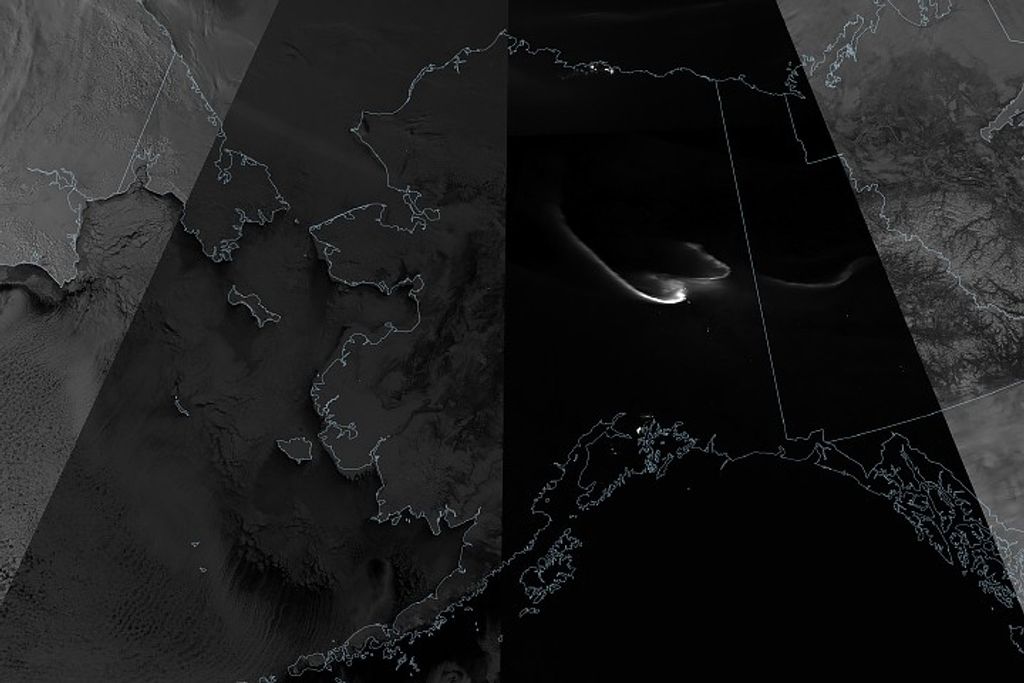
The image above shows the aurora over Alaska very early on November 5, 2018. The light was so bright that it illuminated the terrain below. The aurora likely appeared brighter that night because it occurred two days before a new moon, meaning the sky was darker than at other times in the lunar cycle.
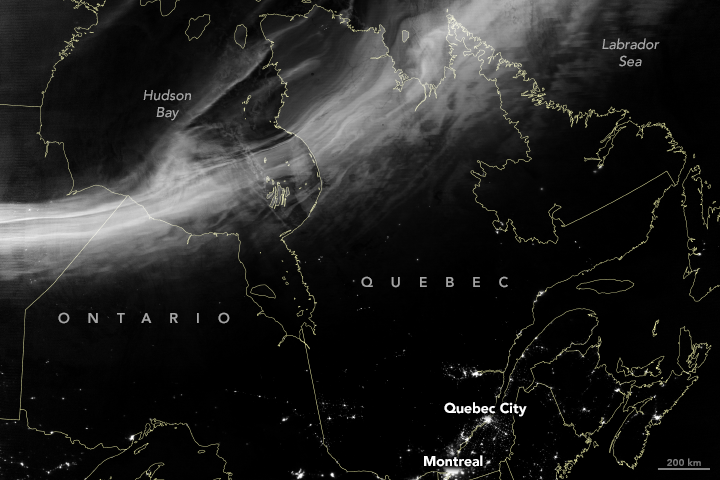
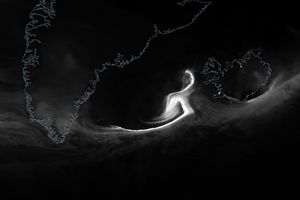
The second image shows the aurora over eastern Canada on November 12. Satellite imagery and ground reports indicate the aurora was also visible from Alaska, Norway, and Scotland around that time.
Both images were acquired by the Visible Infrared Imaging Radiometer Suite (VIIRS) on the Suomi NPP satellite. VIIRS has âday-night bandâ (observing mode) that detects city lights and other nighttime signals such as auroras, airglow, and reflected moonlight. In these images, the sensor detected the visible light emissions that occurred when energetic particles rained down from Earthâs magnetosphere and into the gases of the upper atmosphere.
These auroras come at a time known as solar minimum, a relatively calm period of activity on the Sun that occurs every 11 years or so. During this time, the Sun experiences fewer sunspots and solar flares—phenomena that can lead to auroras.
During a solar minimum, however, auroras are more often caused by coronal holes. These regions of open-ended magnetic fields allow relatively fast streams of solar particles to escape the Sun. This high-speed stream can energize our space environment, shaking Earth’s magnetic bubble enough to trigger auroral displays.
Both auroras were caused by high-speed streams, though from different coronal holes. The coronal hole that sparked the November 5 aurora was particularly notable because it has been persistent for months, said Mike Cook, space weather forecaster lead at Apogee Engineering and team member of the citizen science project Aurorasaurus. This coronal hole first appeared in August 2018, and it has sent high-speed streams toward Earth and caused at least four fairly strong geomagnetic storms around Earth. NASA satellites are currently observing the Sun and Earth to see what may be in store when this coronal hole and others turn toward Earth again.
References & Resources
- Aurorasaurus (2016, January 14) What to expect in entering the solar cycleâs declining phase. Accessed November 20, 2018.
- Anchorage Daily News (2018, November 6) Photos: Northern lights shimmer over Southcentral Alaska. Accessed November 19, 2018.
- NASA Science (2017, June 27) Solar Minimum is Coming. Accessed November 19, 2018.
- Space Weather Live (2018, November 5) NOAA Estimated Kp-index. Accessed November 19, 2018.
- Space Weather Prediction Center (2018, November 5) G2 (Moderate) Geomagnetic Storm Conditions Observed. Accessed November 19, 2018.
NASA Earth Observatory images by Joshua Stevens, using VIIRS day-night band data from the Suomi National Polar-orbiting Partnership. Story by Kasha Patel.