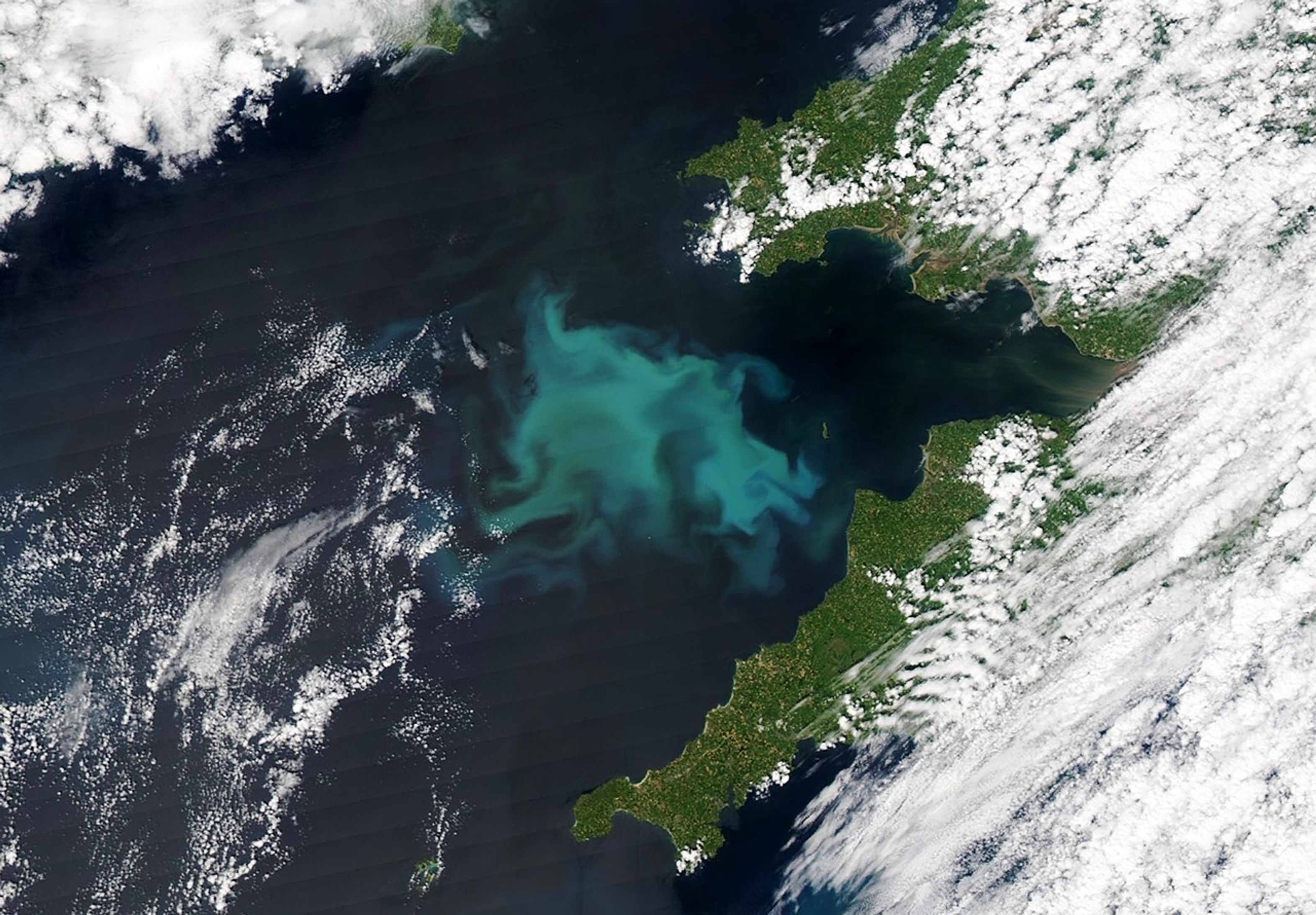


















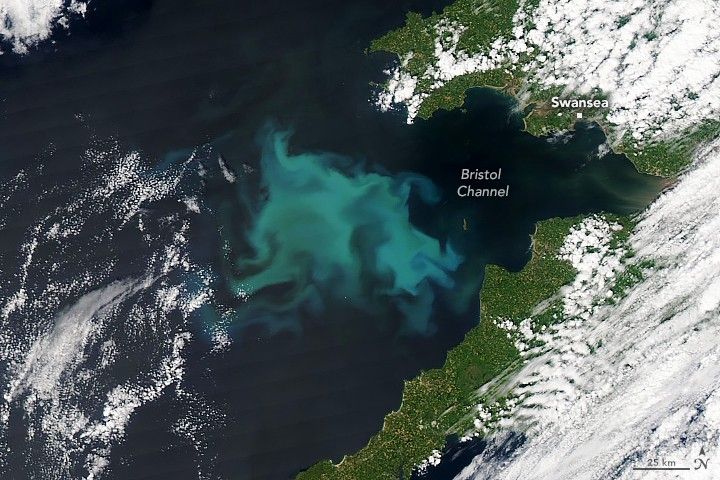
Early summer blooms colored the seas off of southern Wales and southwestern England when NASA’s Aqua satellite passed over the region on June 3, 2022. Bright blue-green waters indicated an abundance of phytoplankton just beyond Bristol Channel.
Hints of a bloom here first appeared in mid-May, as revealed by two weeks of data from the Moderate Resolution Imaging Spectroradiometer (MODIS) on Aqua. (The waters off the southwest coast of Ireland have also been blooming.) The various swirls and shapes in the bloom trace the movements of currents, eddies, and tides.
Phytoplankton are usually most abundant in the far North Atlantic and the North Sea in late spring and early summer, when dissolved nutrient levels are high. Melting snow and ice and spring rains bring increased runoff into the sea, often bearing a heavy load of sediment and organic matter while freshening surface waters. Recent Sahara dust storms also may have dropped nutrients into the sea here. Increasing seasonal sunlight provides the fuel for growth.
The milky, light-colored waters are likely filled with coccolithophores, phytoplankton with calcium carbonate plates that appear chalky white when amassed in great numbers. Greener patches may be rich with diatoms. It is impossible to know for sure without taking direct water samples.
Phytoplankton are microscopic, plant-like organisms that float near the ocean surface and turn sunlight and carbon dioxide into sugars and oxygen. In turn, they become food for the grazing zooplankton, shellfish, and finfish. They also play an important but not fully understood role in the global carbon cycle, taking carbon dioxide out of the atmosphere and eventually sinking it to the bottom of the ocean.
Bristol Channel is the largest natural inlet of the United Kingdom. Freshwater from the River Severn (the UK’s longest) pours into an estuary here and mixes sediment and nutrients into the saltwater. Populations of pollock, whiting, bass, and eels are known to congregate here, as well as several species of porpoises, dolphins, sharks, crabs, and cockles.
In a recent study led by Abigail McQuatters-Gollop of Plymouth University, scientists reported that the types and abundances of plankton in the waters around the United Kingdom have changed significantly in the past six decades. The shifts are likely related to climate change—particularly warming temperatures—and could have long-term effects on the health and distribution of fish, marine mammals, and sea birds in the region.
References & Resources
- Encyclopedia Britannica (2022) Bristol Channel. Accessed June 3, 2022.
- European Union Copernicus (2022, May 31) Phytoplankton bloom in the Bristol Channel. Accessed June 3, 2022.
- McQuatters-Gollop, A. et al. (2019) Plankton lifeforms as a biodiversity indicator for regional-scale assessment of pelagic habitats for policy. Ecological Indicators, (101) 913â925.
- NASA Earth Observatory (2020, June 29) Channeling a Bloom.
- NASA Earth Observatory (2020, April 11) A Sea of Color and Wind.
- NASA Earth Observatory (2011, February 17) As the Seasons Change, Will the Plankton?
- NASA Earth Observatory (2010, July 13) What are Phytoplankton?
- Plymouth Marine Laboratory (2019) First UK-wide assessment of changes in plankton community. Accessed June 26, 2020.
- Weather and Radar - Ireland (2022, June 1) Bristol Channel shines with colour. Accessed June 3, 2022.
NASA Earth Observatory image by Lauren Dauphin, using MODIS data from NASA EOSDIS LANCE and GIBS/Worldview . Story by Michael Carlowicz , with reporting from Joanna Howl, NASA MODIS team.