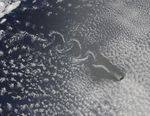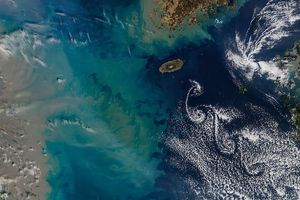


















Mountain peaks slice through the clouds above St. Helena Island, creating Von Karman vortices. Such spiral cloud formations occur commonly in nature, according to Andrew Ackerman, a researcher at NASA’s Goddard Institute for Space Studies. A Von Karman vortex is the same sort of pattern that trails behind a rock in a stream or in the air behind the tip of an airplane wing.
“There’s a lot of turbulence at the edges and not at the middle,” said Ackerman. The planetary boundary layer—the lowest portion of the atmosphere, which reaches down to the Earth’s surface—behaves like the water near the edges of a pipe, curling around itself.
In the image above, St. Helena Island disrupts the clouds, forcing them to bunch up and create spiral patterns as they push past the island. Located in the South Atlantic, the remote island sits more than 1950 kilometers (1,210 miles) west of Africa at the latitude of Namibia and Angola. The highest point, Diana’s Peak, stands 820 meters (2,685 feet) above sea level.
The Moderate Resolution Imaging Spectroradiometer (MODIS) instrument on NASA’s Terra satellite captured this image on November 10, 2015. Another cloud formation, rippling gravity waves, trails to the southwest of the island.
References & Resources
- Earth System Research Laboratory. (2002) Surface and Planetary Boundary Layer Processes.
- Jet Propulsion Laboratory. JPL History: Theodore von Kármán. Accessed September 7, 2016.
- NASA Earth Observatory. (2002, March 14) A Vortex Street in the Arctic.
NASA image by Jeff Schmaltz, LANCE/EOSDIS Rapid Response. Caption by Pola Lem.