

















Billows of light greens and blues spanning hundreds of kilometers brightened the waters of the Celtic Sea in spring 2024. Phytoplankton blooms often appear in northern seas as surface waters grow warmer and receive more sunlight in the spring. Satellites glimpsed the emergence of this colorful area for over a week before the MODIS (Moderate Resolution Imaging Spectroradiometer) on NASA’s Aqua satellite acquired this natural-color image on May 10.
Phytoplankton are tiny, plant-like organisms that often float near the ocean surface. With enough carbon dioxide, sunlight, and nutrients, they can grow in massive numbers. In turn, they form the foundation of the aquatic food web, feeding everything from microscopic zooplankton to shellfish to finfish.
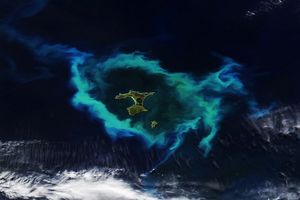
Warming in the spring and early summer sets the stage for stunning blooms to occur in northern waters such as the Celtic Sea, North Sea, and Barents Sea. Early in the season, when waters are well-mixed and nutrients are plentiful, blooms of diatoms tend to dominate. These phytoplankton, with their silica shells and ample chlorophyll, color the surface waters green. As the water warms and stratifies, conditions favor a type of phytoplankton called coccolithophores. Armored with plates of highly reflective calcium carbonate, they make surface waters appear a milky turquoise-blue.
The combination of colors in this bloom may be due to a mix of phytoplankton types. Alternatively, the variety of hues may stem from abundant colored dissolved organic matter in the vicinity of the bloom, which can make seawater appear anywhere from green to yellow-green to brown depending on the concentration.
Determining which phytoplankton species are present within a bloom has only been possible by analyzing water samples. However, scientists could soon be able to distinguish phytoplankton types from space. The OCI (Ocean Color Instrument) on NASA’s PACE (Plankton, Aerosol, Cloud, ocean Ecosystem) satellite, launched in February 2024, can detect hundreds of wavelengths of light and may be able to reveal the species makeup of blooms such as these.
References & Resources
- International Council for the Exploration of the Sea Celtic Seas ecosystem overview. Accessed May 14, 2024.
- NASA Earth Observatory (2021, July 25) Beauty in the Barents. Accessed May 14, 2024.
- NASA Earth Observatory (2024, May 8) Complex Beauty in the Gulf of Oman. Accessed May 14, 2024.
- NASA Missions PACE. Accessed May 14, 2024.
- Shelf Sea Biogeochemistry Springtime phytoplankton blooms in the Celtic Sea. Accessed May 14, 2024.
NASA Earth Observatory image by Michala Garrison, using MODIS data from NASA EOSDIS LANCE and GIBS/Worldview . Story by Lindsey Doermann .