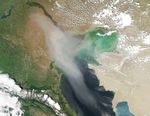








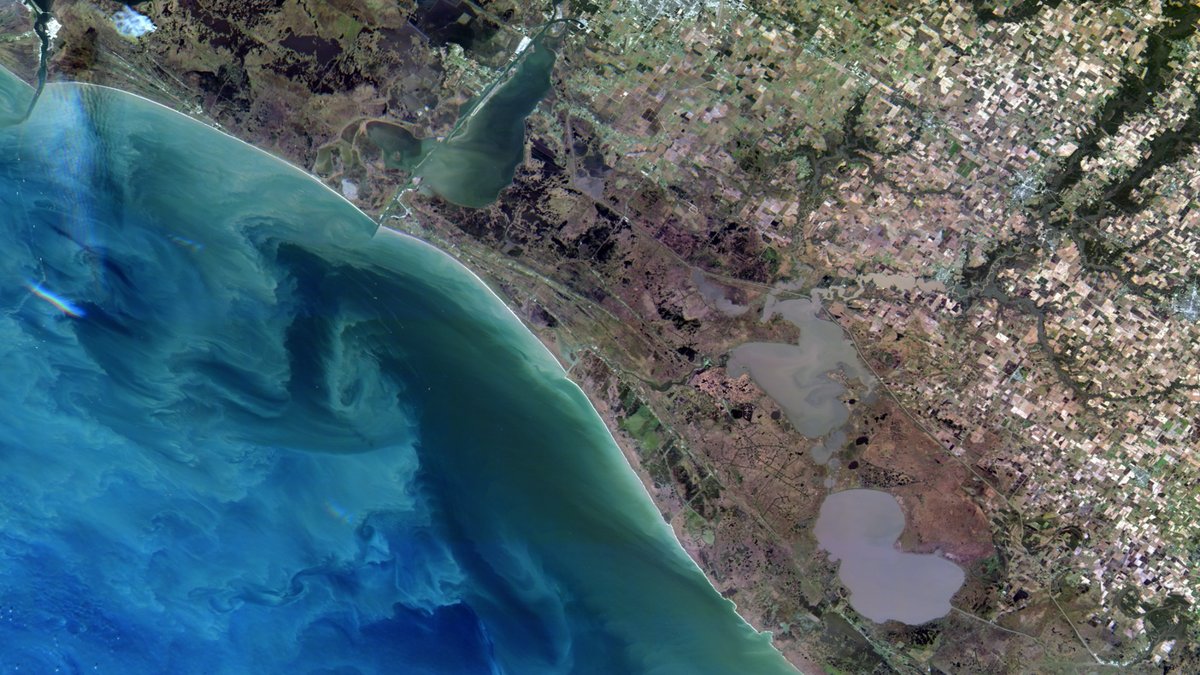








On May 18, 2014, the Moderate Resolution Imaging Spectroradiometer (MODIS) on NASA’s Aqua satellite acquired this natural-color image of dust blowing over the Kalmykia and Astrakhan regions in Russia. Dune fields west of the Volga River appear to be the source of some of the dust. A longer plume, most likely made of dust from Turkmenistan, is also visible crossing the Caspian Sea.
Covering an area of roughly 371,000 square kilometers (143,200 square miles), the Caspian Sea is the world’s largest salt lake. The water appears green in its shallow northern part, where it has an average depth of just 5 to 6 meters (16 to 20 feet). The southern part of the Caspian Sea is much deeper and appears dark blue.
References & Resources
- Earth Observatory (2010, June 12) Caspian Sea.
- Encyclopedia of Earth (2014, May 16) Caspian lowland desert. Accessed May 21, 2014.
- Russia Profile Republic of Kalmykia. Accessed May 21, 2014.
- Russia Profile Astrakhan Region. Accessed May 21, 2014.
- Russia Trek One of the highest sand dunes in Astrakhan oblast. Accessed May 21, 2014.
NASA images by Jeff Schmaltz, LANCE/EOSDIS Rapid Response. Caption Adam Voiland.