
















Spring and early summer are generally dusty in the Borderplex region of the Chihuahuan Desert—a transnational area that spans parts of southern New Mexico, West Texas, and the Mexican state of Chihuahua. With the region gripped by exceptional drought, this has been especially true in 2025.
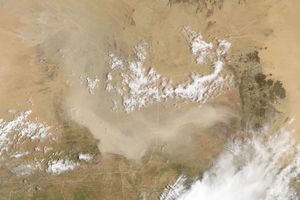
The latest in a string of storms lofted particles from dried lakes and other parched sources in northern Chihuahua and New Mexico and sent them streaming toward El Paso, Juárez, and Las Cruces. The MODIS (Moderate Resolution Imaging Spectroradiometer) on NASA’s Aqua satellite captured this image on April 27, 2025. The event followed a large dust storm that hit the region a week earlier, as well as other major dust storms in early and mid-March.
Research indicates that March, April, and May are typically the most active months for airborne dust in El Paso. But the dust season so far this year has been “truly exceptional—one for the record books,” said Thomas Gill, an environmental scientist at the University of Texas at El Paso. For decades, Gill has used satellite observations and models to track dust activity around the planet and in the Borderplex region.
He said this latest event is the tenth “full-fledged dust storm” of the year in El Paso, meaning it was dusty enough to restrict visibility to less than half a mile. For comparison, the average is 1.8 storms per year. “You would have to go back to 1936—during the Dust Bowl—to find a year with more,” Gill said. During the Dust Bowl years of 1935 and 1936, El Paso had 13 and 11 dust storms, respectively.
Unusual drought and windy conditions are fueling the surge in dust. “We’re in the worst drought we’ve seen in at least a decade, and this March was the windiest we’ve seen in more than 50 years,” Gill added.
Research shows dust storms can pose considerable hazards. In a 2023 analysis, Gill and several colleagues pointed out that the dangers of dust are often underappreciated. They contribute to deadly traffic accidents and elevate the risk of cardiorespiratory problems that lead to emergency room visits.
Dust may also help spread a fungal infection called Valley Fever, though the precise role of dust storms remains a topic of ongoing research and debate. In another analysis, Gill and colleagues estimated that dust storms cause more than $150 billion in economic damage each year, with farmers, the health care sector, the renewable energy industry, and households bearing large costs.
Several tools powered by NASA data and satellites are available to meteorologists, scientists, and others tracking dust storms. The Worldview browser hosts timely data and imagery from several satellites, and NASA’s Global Modeling and Assimilation Office has tools for real-time weather analysis and reanalysis.
Gill collaborates frequently with a NASA-sponsored health and air quality team led by George Mason University’s Daniel Tong. That team is working to develop better ways of forecasting and analyzing how dust storms can affect air quality. Researchers with NASA’s SPoRT (Short-term Prediction Research and Transition) project have also developed a new technique that uses machine learning to improve the tracking of dust plumes at night.
“It should be interesting to see how far the dust from this event travels,” noted Santiago Gasso, a University of Maryland atmospheric scientist based at NASA’s Goddard Space Flight Center. “Some of it could be headed to the Great Lakes, New England, and maybe even to Greenland, as happened after one of the storms in March.”
Up to this point in the 2025 season, the Borderplex region has seen 28 days with dust. Over the past quarter century, the average for an entire year is 22 days. “We still have several more weeks of the dust season to go,” added Gill, noting that forecasters are warning of more dust as early as this weekend.
References & Resources
- Comrie, A. et al. (2021) No Consistent Link Between Dust Storms and Valley Fever (Coccidioidomycosis). GeoHealth, 5(12), e2021GH000504.
- El Paso Matters (2025, March 12) El Paso ranked among most-polluted major U.S. cities in 2024. And 2025 may be worse. Accessed April 29, 2025.
- El Paso Matters (2025, February 20) Above-average winds and long-term drought affect El Paso’s air quality. Accessed April 29, 2025.
- NASA SPoRT Viewer — Near Real-Time: Machine Learning: GOES East DustTracker-AI. Accessed April 29, 2025.
- NASA (2021, June 23) Dust in the Machine. Accessed April 29, 2025.
- National Weather Service (2025, April 9) Drought Information Statement for Southern NM/Far West TX. Accessed April 29, 2025.
- Nature (2022, August 1) Dust-up over dust storm link to “Valley Fever’ disease. Accessed April 29, 2025.
- Novlan, D. et al. (2007) A synoptic climatology of blowing dust events in El Paso, Texas from 1932-2005. Accessed April 29, 2025.
- Robinson, M., & Ardon-Dryer, K. (2024) Characterization of 21 years of dust events across four West Texas regions. Aeolian Research, 67-69, 100930.
- Texas Commission on Environmental Quality (2025, April 25) This past week brings little change in the total area of drought, but a significant increase in intensity. Accessed April 29, 2025.
- Tong, D., et al. (2022) Dust Storms, Valley Fever, and Public Awareness. Reviews of Geophysics, 6(8), e2022GH000642.
- Tong, D., et al. (2023) Health and safety effects of airborne soil dust in the Americas and beyond. Reviews of Geophysics, 61(2), e2021RG000763.
- Tong, D., et al. (2023) How many people were killed by windblown dust events in the United States? Bulletin of the American Meteorological Society, 104(5), E1067-E1084.
- Rowan, C., et al. (2024) Dust storms and cardiorespiratory emergency department visits in three Southwestern United States: Application of a monitoring-based exposure metric. Environmental Research: Health, 2(3), 031003.
- University of Texas at El Paso (2025, February 6) Dust storms and wind erosion cause $154 billion in damages annually, study shows. Accessed April 29, 2025.
NASA Earth Observatory image by Wanmei Liang , using MODIS data from NASA EOSDIS LANCE and GIBS/Worldview . Story by Adam Voiland .