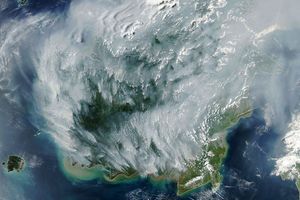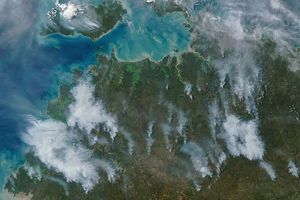




















In the savannas of West Africa, thousands of fires were detected by the Moderate Resolution Imaging Spectroradiometer (MODIS) on NASA’s Aqua satellite on December 18, 2005. In this part of Africa, people set fires for a variety of purposes, for example, to stimulate new growth of pasture vegetation and to hunt wild game. Although intentional burning of the savannas has long been part of the region’s pastoral and agricultural cultures, the fires are not without hazard. If they burn too hot, they can damage the soil and contribute to erosion and desertification, and they create air pollution, which can linger over the savannas for weeks at a time during the dry season.
The high-resolution image provided above has a spatial resolution of 1 kilometer per pixel. The MODIS Rapid Response System provides images of the region at additional resolutions.
References & Resources
NASA image courtesy the MODIS Rapid Response Team, Goddard Space Flight Center