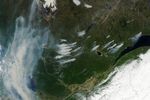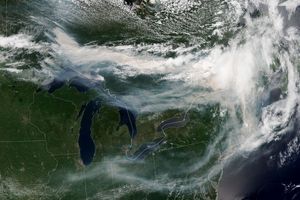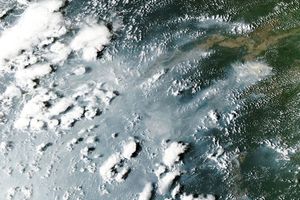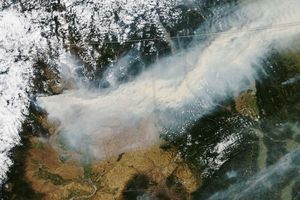



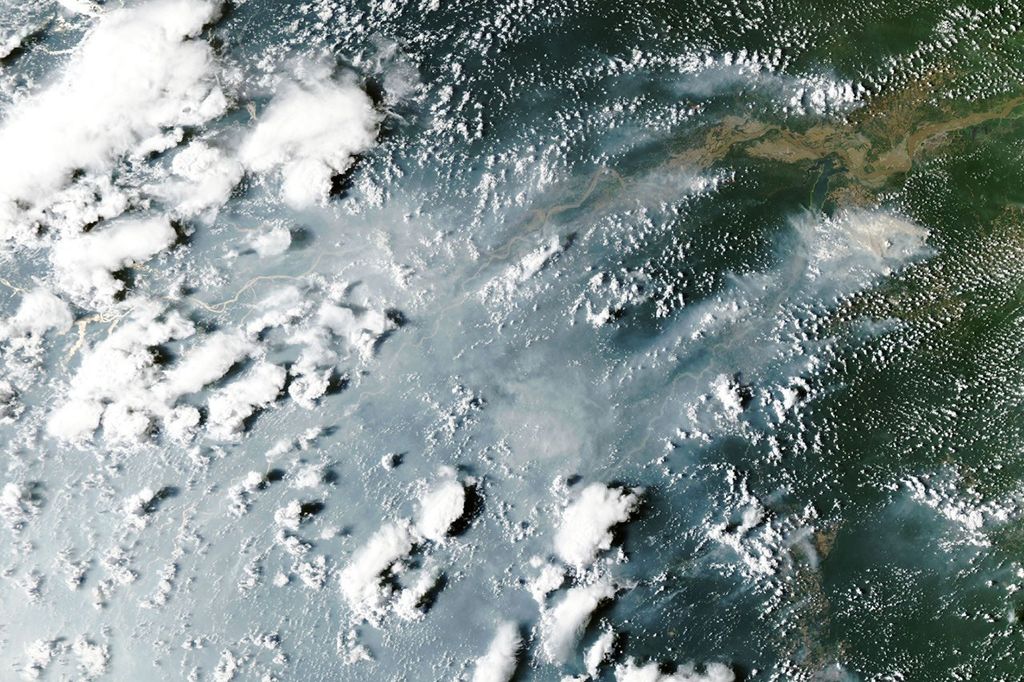















An unusually intense start to Canada’s wildfire season filled skies with smoke in May 2023. Then, at the beginning of June, scores of new fires raged in the eastern Canadian province of Quebec, some of which were ignited by lightning.
The Moderate Resolution Imaging Spectroradiometer (MODIS) on NASA’s Aqua satellite captured this view of smoke billowing from the fires on June 3. Shortly after the fires started, about 5,000 residents were ordered to evacuate near the city of Sept-Îles in the province’s east. As the fires grew, evacuations were extended to an additional 9,000 people in surrounding communities and in western Quebec’s Val-d’Or and Normétal municipalities. As of June 5, more than 150 wildfires were active in Quebec.
Smoke from the blazes prompted air quality warnings across Quebec and Ontario. On June 4, the air quality index for fine particulate matter (PM 2.5) was classified as unhealthy in southern Quebec and eastern Ontario, according to NOAA’s Aerosol Watch. Fine particulate matter from the smoke blew down to the U.S. Midwest, where it made the air quality unhealthy for sensitive groups in parts of Minnesota, Wisconsin, Illinois, and Michigan.
Fire season in Quebec usually starts in late May. In an average year, only 247 hectares (a square mile) of area would be burned by June 5, according to Quebec’s fire prevention agency (SOPFEU). But so far this year, 160,000 hectares (600 square miles) have burned.
The fire prevention agency said the fierce start to the season has in part been due to high temperatures and dry conditions in the province.
References & Resources
- CBC Canada (2023, June 2) Forest fires force thousands out of their homes in Quebec’s North Shore. Accessed June 5, 2023.
- CBC Canada (2023, June 4) Quebec fire authorities say they're unable to bring all fires under control. Accessed June 5, 2023.
- CBC Canada (2023, June 5) Massive forest fires are coating much of Quebec in haze and smoke. Accessed June 5, 2023.
- NASA Earth Observatory (2023, June 1) Raging Fires in Nova Scotia.
- NASA Earth Observatory (2023, May 18) Summer Temperatures Arrive Early.
- NASA Earth Observatory (2023, May 26) A Smoky May for North America.
- NASA Earth Observatory (2023, May 9) Fires Scorch Western Canada.
- NBC News (2023, June 5) Air quality levels in parts of the U.S. plunge as Canada wildfires rage. Accessed June 5, 2023.
- NOAA Aerosol Watch, via Twitter (2023, June 5) Daily Fine Particulates, June 4, 2023. Accessed June 5, 2023.
- Société de protection des forêts contre le feu (SOPFEU) (2023, June 5) Fire Activity. Accessed June 5, 2023.
- Société de protection des forêts contre le feu (SOPFEU) (2023, June 1) Press Release: Quebec asks to avoid driving and practicing activities in the forest. Accessed June 5, 2023.
NASA Earth Observatory image by Lauren Dauphin, using MODIS data from NASA EOSDIS LANCE and GIBS/Worldview . Story by Emily Cassidy .