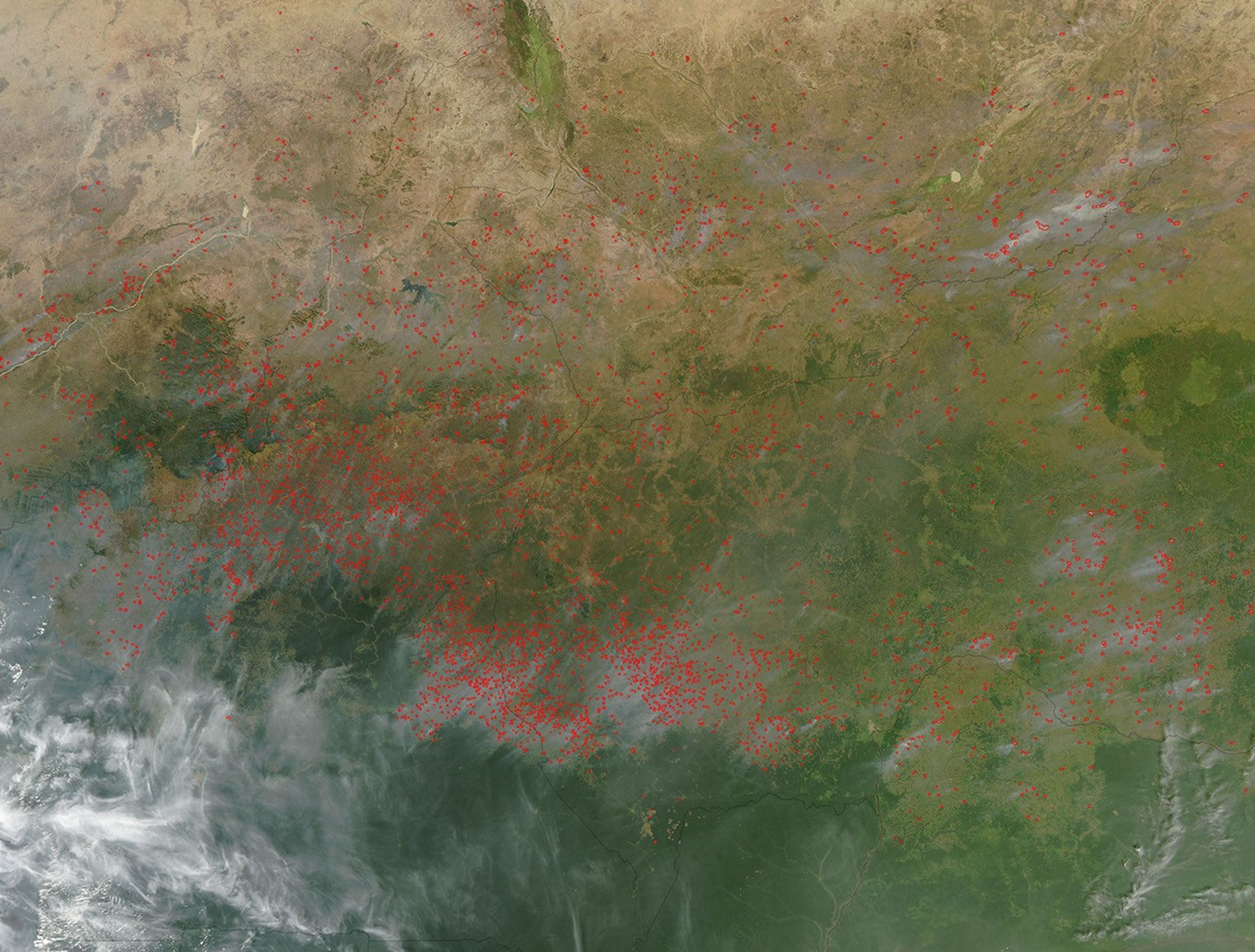

















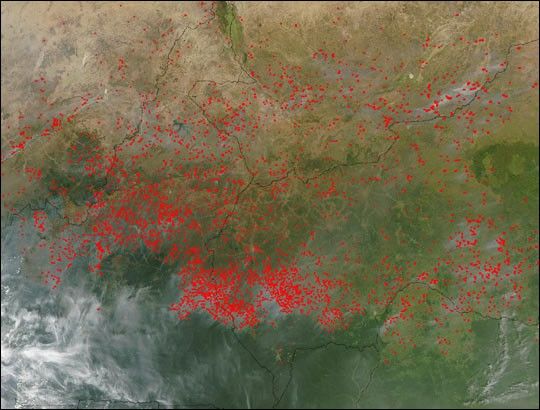
Fire season in Africa south of the Sahara Desert has roared to life in December 2003. This image from the Moderate Resolution Imaging Spectroradiometer (MODIS) on the Aqua satellite shows the location of more than 7,000 “hot pixels,” which means that somewhere in each of those 1-square-kilometer pixels, MODIS detected a fire. In some cases these “hot spots” are isolated fires no larger than 1 square kilometer (and usually much smaller), and in other cases, they are a single large fire spread across several square kilometers. In this scene, these active fire detections have been marked in red.
This scene spans three general biomes. In the top of the scene lies the almost-desert region known as the Sahel. Farther from the Sahara, toward the center of the scene, the Sahel becomes savanna. Along the bottom third of the image, tropical forests stretch in a deep green expanse that is punctuated by clearings and roads. Countries shown are (clockwise from top left) Nigeria, Cameroon, Chad, Central African Republic, Democratic Republic of Congo, and Congo.
The high-resolution image provided above is 500 meters per pixel. The MODIS Rapid Response System provides this image at multiple spatial resolutions, including MODIS’ maximum resolution of 250 meters.
References & Resources
Image courtesy Jacques Descloitres, MODIS Rapid Response Team at NASA GSFC.