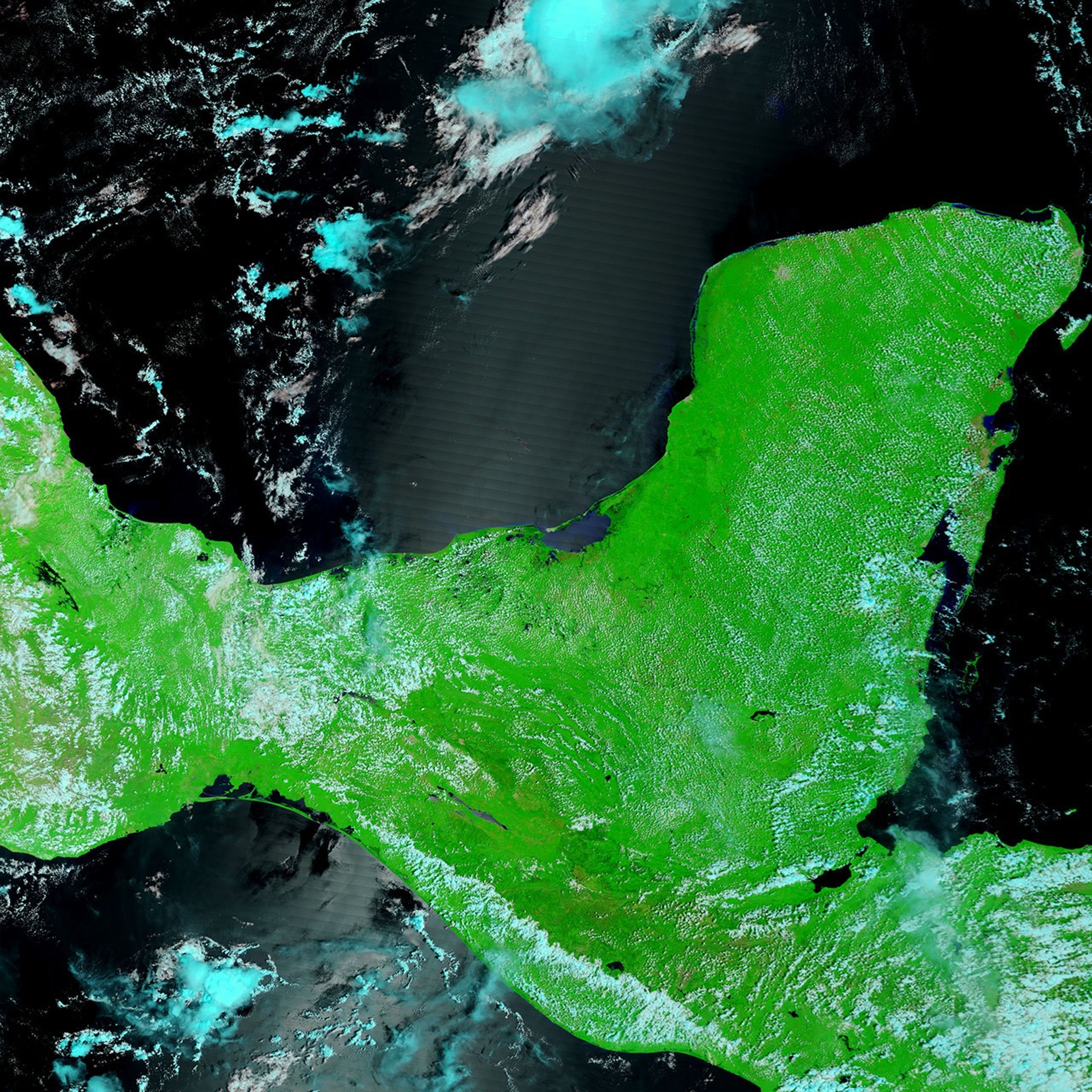























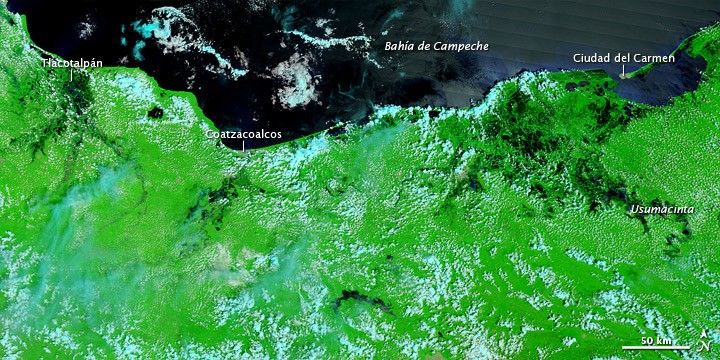
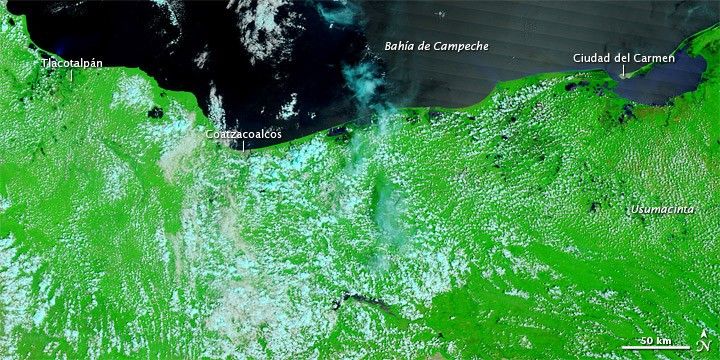
Flood conditions extended along Mexico’s southern Gulf Coast in late September 2010, affecting the states of Veracruz, Tabasco, and Campeche. Flood conditions were already severe along the coast earlier in the month, and the arrival of Hurricane Karl only added to the moisture. ReliefWeb reported that the August-September rainy season of 2010 was one of the region’s wettest on record.
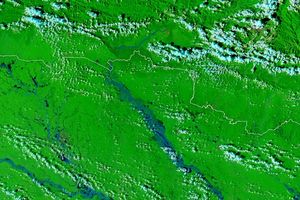
The Moderate Resolution Imaging Spectroradiometer (MODIS) on NASA’s Terra satellite captured these images on September 20, 2010 (top), and just over a year earlier, on September 17, 2009 (bottom). Both images use a combination of infrared and visible light to increase the contrast between water and land. Water is navy blue, and vegetation is bright green. Clouds appear in varying shades of blue-green.
Wetlands occur in multiple locations along the coast, including the areas around Tlacotalpán, Coatzacoalcos, and the Usumacinta River. Each of these areas shows a dramatic increase in standing water in late September 2010.
On September 20, 2010, the Associated Press reported that several days of floods and mudslides had caused at least 16 deaths in southern Mexico. Two weeks earlier, the death toll from earlier floods in the region stood at 50.
The MODIS Rapid Response team provides daily images of this area.
References & Resources
- Agence France-Presse. (2010, September 21). 12 dead in Mexico hurricane, as looting spirals: officials. ReliefWeb. Accessed September 21, 2010.
- Associated Press. (2010, September 20). Death toll rises to 16 in Mexico from flooding. Accessed September 21, 2010.
NASA images courtesy MODIS Rapid Response Team at NASA GSFC. Caption by Michon Scott.