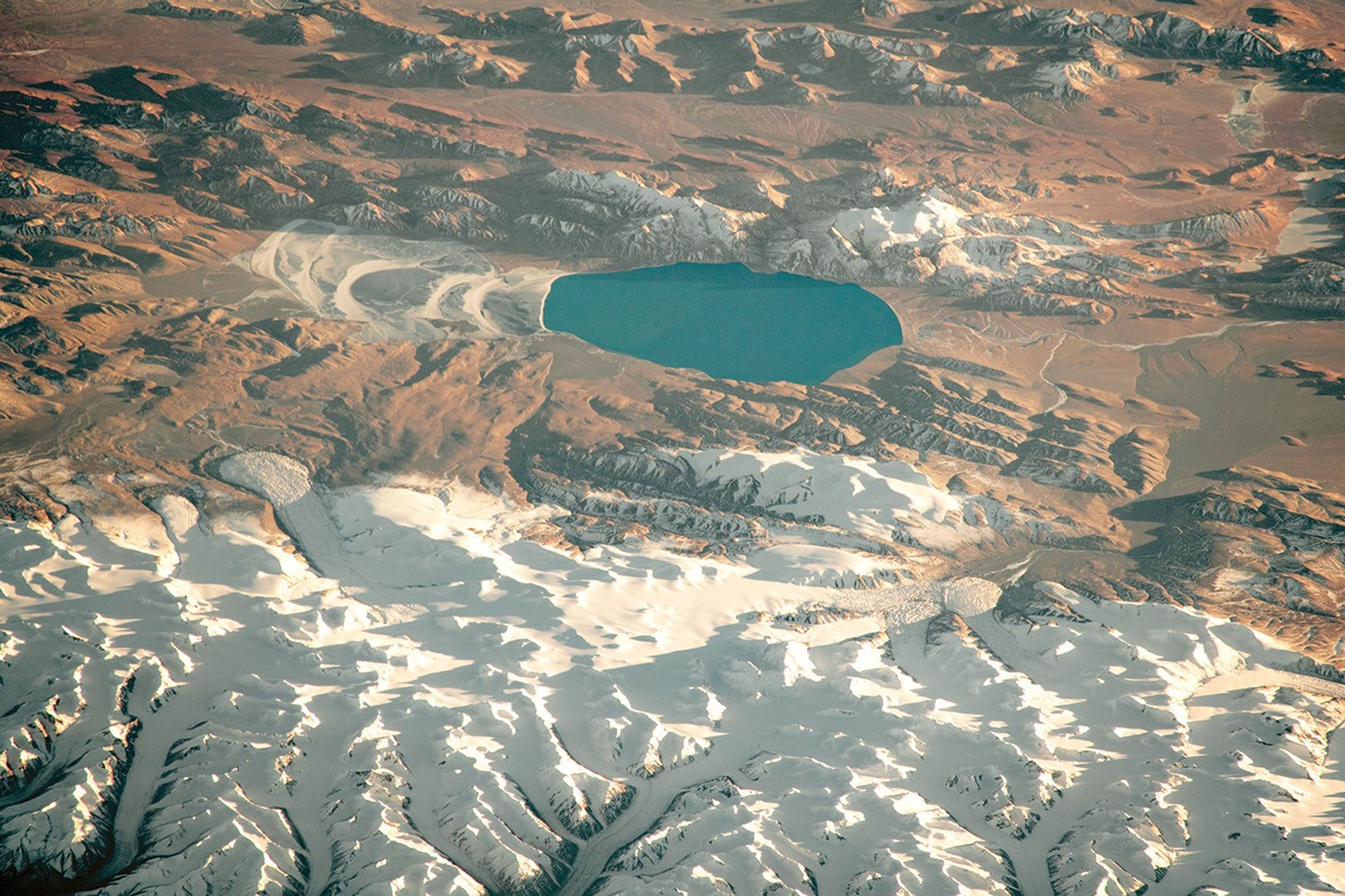











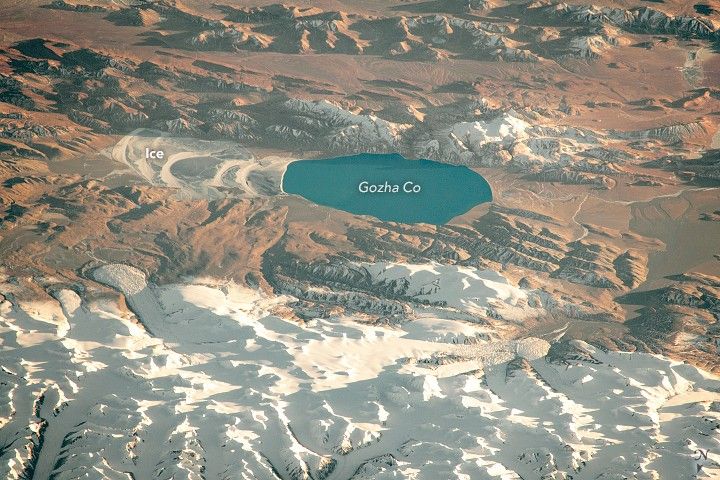
An astronaut on the International Space Station took this oblique photograph of glaciers in the Kunlun Mountains of Central Asia. South of the glaciers lies the partially frozen Gozha Co, one of hundreds of lakes on the Tibetan Plateau. (Note that the astronaut was looking south, so north is on the bottom of this image.)
Long glaciers extend down from the mountain peaks into the valleys, with several ending in rounded or lobe-shaped tongues. The bulbous shape is due to the spreading of ice over a flatter landscape. These glaciers feed melt water into nearby Gozha Co. (Co means lake in the Tibetan language.) Just beyond the glacier tongues, moraine deposits trace out former ice edges.
The Gozha Co basin originated from tectonic activity that formed several east-west trending basins in the region. It later filled with melt water flowing in from the surrounding glaciers and from seasonal snow.
Lakes on the Tibetan Plateau start to freeze between October and December and some stay solid until May. This photo was taken at the beginning of the winter freeze-up, and ice layers on the east (left) side of the lake show different stages of freezing. About two weeks before this photo was shot, ice was absent from the lake. By mid-December, Gohza Co was completely frozen.
References & Resources
Astronaut photograph ISS057-E-106614 was acquired on November 30, 2018, with a Nikon D5 digital camera using a 500 millimeter lens and is provided by the ISS Crew Earth Observations Facility and the Earth Science and Remote Sensing Unit, Johnson Space Center. The image was taken by a member of the Expedition 57 crew. The image has been cropped and enhanced to improve contrast, and lens artifacts have been removed. The International Space Station Program supports the laboratory as part of the ISS National Lab to help astronauts take pictures of Earth that will be of the greatest value to scientists and the public, and to make those images freely available on the Internet. Additional images taken by astronauts and cosmonauts can be viewed at the NASA/JSC Gateway to Astronaut Photography of Earth. Caption by Sara Schmidt, GeoControl Systems, and Andrea Meado, Jacobs Technology, JETS Contract at NASA-JSC.