
















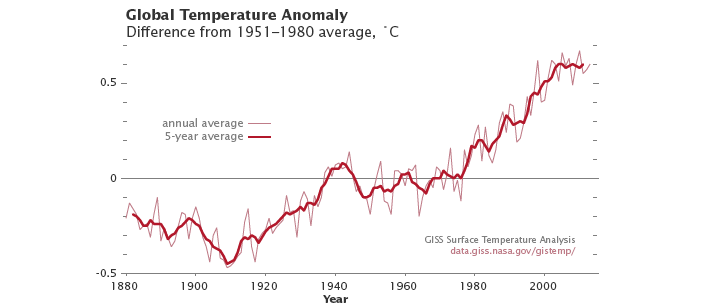
This figure plots global surface temperature anomalies from 1880 through 2013. It does not show absolute temperatures, but instead shows how much warmer or cooler the Earth was compared to the averaged base period from 1951 to 1980. The thin red line shows the annual temperature anomaly, while the thicker red line shows the five-year running average, a number that helps smooth out extreme fluctuations upward or downward.
Climatologists at NASA’s Goddard Institute for Space Studies compile publicly available weather data from more than 6,000 meteorological stations around the world, satellite observations of sea-surface temperature, and Antarctic research station measurements, taking into account station history and urban heat island effects. Software is used to calculate the difference between surface temperature in a given month and the average temperature for the same place from 1951 to 1980. This three-decade period functions as a baseline for the analysis.
Read more about 2013 global temperatures here. For more explanation of how the GISS temperature analysis works, read World of Change: Global Temperatures.
References & Resources
NASA images by Robert Simmon, based on data from the NASA Goddard Institute for Space Studies, NOAA National Climatic Data Center, Met Office Hadley Centre/ Climatic Research Unit, and the Japanese Meteorological Agency. Caption by Mike Carlowicz.