









Impact craters, like those we observe on the moon, also occur on Earth. They result from the collisions of extraterrestrial bodies (like meteorites, asteroids or comets) with the Earth. Planetary scientists study Earth’s impact craters to gain insight about the early history of the Earth and the Solar System. Recent studies indicate that large impacts on Earth may have played an important role in the succession of life on Earth.
Australia is a very good place to observe and study impact craters. Much of the Australian surface is very old, so Australia has collected more impacts than many other parts of the world. Because of the dry climate, the craters haven’t weathered away, nor are they hidden by dense vegetation.
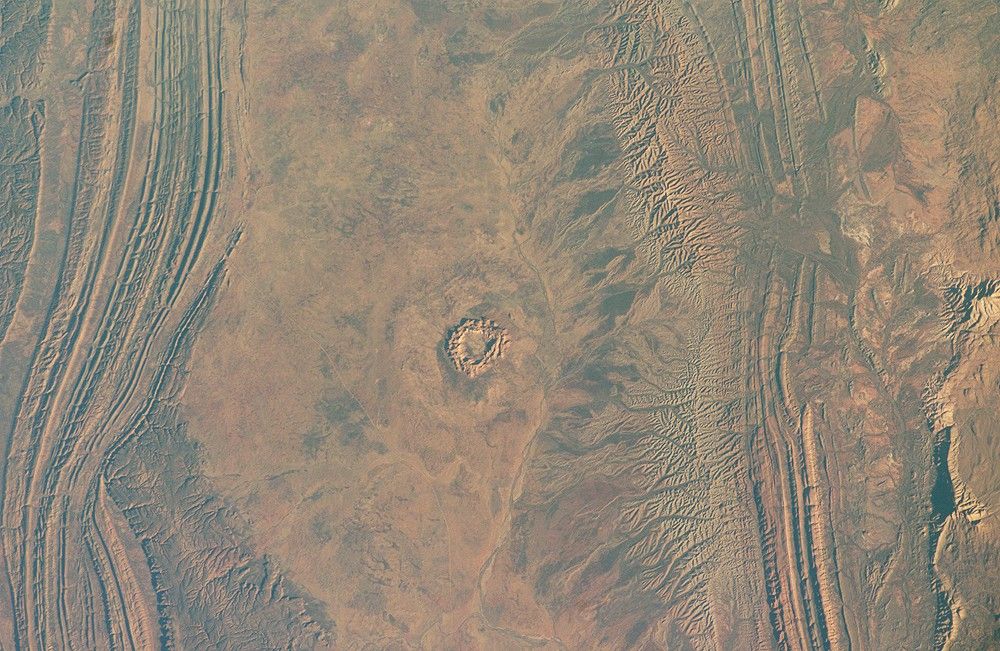
This image shows Gosses Bluff, an impact crater sandwiched between the Macdonnell Range to the north and the James Range to the south in Australia’s Northern Territory—it is about 160 km west of Alice Springs. It is one of the most studied of the Australian impact craters. The impactor, an asteroid or comet, was probably about 1 km in diameter and crashed into the earth about 142 million years ago. The isolated circular feature within the crater consists of a central ring of hills about 4.5 km in diameter. The grayish feature surrounding the inner ring probably marks the original boundary of the outer rim.
References & Resources
Astronaut photograph ISS007-E-05697 was taken with an Electronic Still Camera on May 20, 2003 with a 180-mm lens and is provided by the Earth Sciences and Image Analysis Laboratory at Johnson Space Center. Additional images taken by astronauts and cosmonauts can be viewed at the NASA-JSC Gateway to Astronaut Photography of Earth.