

















Heat waves are not unusual in Australia. A subtropical belt of high pressure that flows over the continent regularly delivers pulses of hot, dry air to the surface in the summer. Yet even by Australian standards, the intense heat wave of February 2017 has been remarkable.
When a high-pressure system stalled over central Australia, extreme temperatures emerged first in South Australia and Victoria and then spread to New South Wales, Queensland, and Northern Territory. With overheated bats dropping from trees and bushfires burning out of control, temperatures smashed records in many areas.
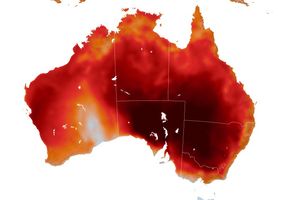
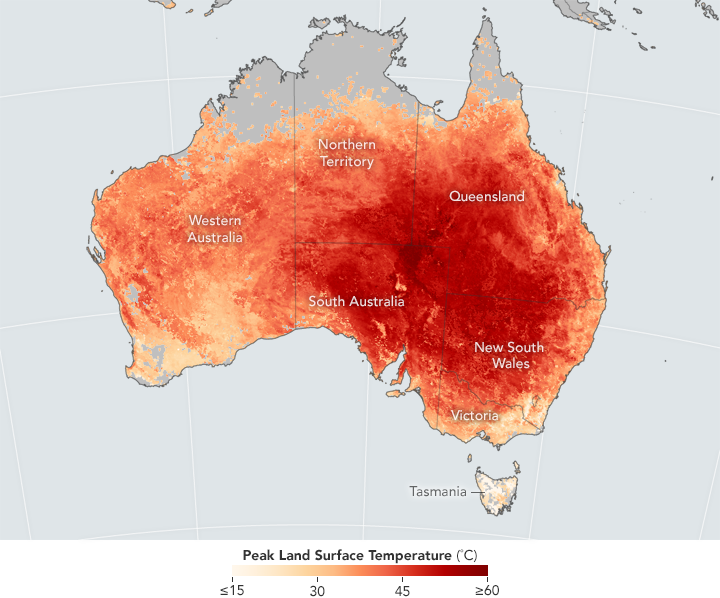
This map shows peak land surface temperatures between February 7 and 14, 2017, a period when some of the most extreme heating occurred. The map is based on data collected by the Moderate Resolution Imaging Spectroradiometer (MODIS) on NASA’s Terra satellite. Note that it depicts land surface temperatures, not air temperatures. Land surface temperatures reflect how hot the surface of the Earth would feel to the touch in a particular location. They can sometimes be significantly hotter or cooler than air temperatures. (To learn more about LSTs and air temperatures, read: Where is the Hottest Place on Earth?)
On February 12, 2017, air temperatures rose to 46.6°C (115.9°F) in the coastal city of Port Macquarie, New South Wales, breaking the city’s all-time record by 3.3 degrees Celsius (5.9 degrees Fahrenheit). Two days earlier, the average maximum temperature across all of New South Wales hit a record-setting 42.4°C (108.3°F)—a record that was broken the next day when it rose to 44.0°C (111.2°F).
In some places, the duration of the heatwave has been noteworthy. Mungindi, a town on the border of Queensland and New South Wales, endured 52 days in a row when maximum temperatures exceeded 35°C (95°F)—a record for New South Wales.
Many scientists see exceptional heat waves like this as part of a broader trend. For instance, one study published by the Climate Council of Australia concluded that heatwaves—defined as at least three days of unusually high temperatures—grew significantly longer, more intense, and frequent between 1971 and 2008.
References & Resources
- 9News (2017, February 13) NSW weather records break over scorching weekend.
- Climate Council (2014) Heatwaves: Hotter, Longer, More Often. Accessed February 17, 2017.
- Macquarie Port News ( 2017, February 13) Port Macquarie registers its hottest day on record. Accessed February 17, 2017.
- New Scientist (2017, February 13) Australia’s extreme heatwave is a preview of things to come. Accessed February 17, 2107.
- The Conversation (2017, February 11) Climate change doubled the likelihood of the New South Wales heatwave. Accessed February 17, 2107.
NASA Earth Observatory image by Jesse Allen, using data from the Land Processes Distributed Active Archive Center (LPDAAC). Caption by Adam Voiland.
None