


























- Quicktime (.mov) format (576 KB)
- MPEG-1 (.mpg) format (1.1 MB)
SOUTHEAST SOAKED BY FRONTAL SYSTEM, BONNIE, AND CHARLEY
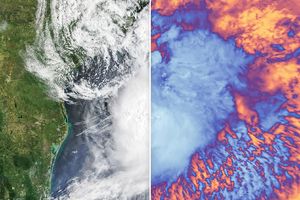
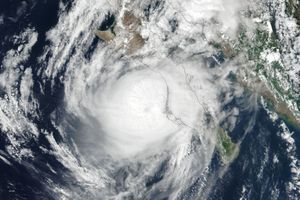
A stalled frontal system along the eastern seaboard and landfalls from TropicalStorm Bonnie and Hurricane Charley combined to drench the southeast US fromFlorida up through the coastal midatlantic region. First, a stationary frontdraped along the Appalachians provided the focus for showers and thunderstormsfrom the Florida panhandle up through the midatlantic. Next, Tropical StormBonnie made landfall in the panhandle of Florida on the 12th of August, 2004near Apalachicola after forming in the south central Gulf of Mexico. Bonniemoved rapidly across north Florida and into southeastern Georgia after comingashore. The system was quickly sheared apart and lost its identity as it madelandfall. Finally, Hurricane Charley, the most powerful hurricane to strikeFlorida since Hurricane Andrew back in 1992, made landfall on the afternoon ofthe 13th of August at Captiva Island on the southwest coast of Florida nearPunta Gorda after having crossed over Cuba during the night. Charley remaineda hurricane as it cut diagonally north-northeast across the Florida peninsula.The storm then briefly re-emerged over the Atlantic before making a secondlandfall on the Carolina coast. Charley finally weakened into a tropical stormover coastal North Carolina before racing northeast across the mouth of theChesapeake Bay and back out to sea. An upper-level trough was responsible forsteering both Bonnie and Charley rapidly off to the north and east.
In November of 1997, the Tropical Rainfall Measuring Mission satellite waslaunched in an effort to provide better estimates of rainfall over the globalTropics. Since that time, TRMM has been providing un-precedented estimates ofrainfall over the Tropics using its array of passive and active sensors. TRMMcan cover vast areas of the Tropics where rainfall is poorly measured such asover oceans and land areas where radar coverage is poor or lacking. The TRMM-based, near-real time Multi-satellite Precipitation Analysis (MPA) at the NASAGoddard Space Flight Center provides rainfall estimates over the global Tropics.MPA rainfall totals for the period 9-14 August 2004 are shown for the SoutheastUS and northern Caribbean. A swath of 3 to 5 inch rainfall (green area) extendsfrom the central Gulf of Mexico into northern Florida as a result of Bonnie. Aheavier swath of rain containing 3 to 10 inch amounts (darker red areas) extendsfrom the north central Caribbean up through Cuba across Florida and merges witha heavy rain area along the Carolina coast. This marks the path of Charley.Rainfall amounts associated with these two storms were not excessive as bothsystems moved quickly. Tropical storm and hurricane symbols indicate the pathsof Bonnie and Charley.
TRMM is a joint mission between NASA and the Japanese space agency JAXA.
References & Resources
Images produced by Hal Pierce (SSAI/NASA GSFC) and caption by Steve Lang (SSAI/NASA GSFC), NASA's Tropical Rainfall Measuring Mission.