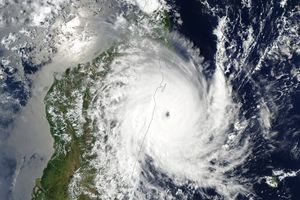













Churning over the warm waters of the Caribbean Sea, Gustav formed very quickly on August 25, 2008. Within 24 hours between August 25 and August 26, the storm went from tropical depression to a strong Category 1 hurricane, with sustained winds of 150 kilometers per hour (92 miles per hour or 80 knots). Gustav was poised to strike Haiti and the Dominican Republic on August 26, when the QuikSCAT satellite captured the data used to make this image.
The image shows wind speed and direction in the storm. The strongest winds, shown in purple, were located in the center of the storm. The calm air outside the storm system is represented in blue. The barbs illustrate wind direction, and white barbs show regions of heavy rain.
QuikSCAT measures wind by sending pulses of microwave energy through the atmosphere to the ocean and recording the energy that bounces back from the wind-roughened surface. The energy of the microwave pulses changes depending on wind speed and direction.
The wind speeds shown in this image may be lower than winds recorded on the ground. To relate the radar signal to actual wind speed, scientists compare measurements taken from buoys and other ground stations to data the satellite acquired at the same time and place. Because the high wind speeds generated by cyclones are rare, scientists do not have corresponding ground information to know how to translate data from the satellite for wind speeds above 50 knots (about 93 km/hr or 58 mph).
Also, the unusually heavy rain found in a cyclone distorts the microwave pulses in a number of ways, making a conversion to exact wind speed difficult. Instead, the scatterometer provides a nice picture of the relative wind speeds within the storm and shows wind direction.
References & Resources
NASA image courtesy of David Long, Brigham Young University, on the QuikSCAT Science Team, and the Jet Propulsion Laboratory. Caption by Jesse Allen.