



















- Quicktime (.mov) format (1.6 Mb)
- MPEG-1 (.mpg) format (572 kb)
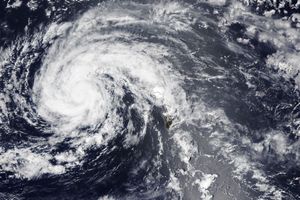
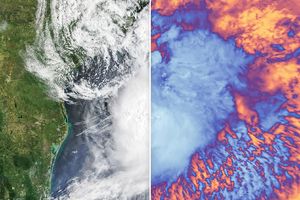
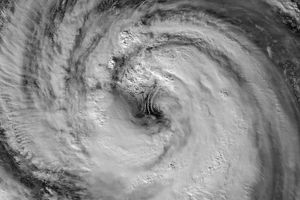
Isabel, which was once a powerful Category 5 hurricane in the centralAtlantic with winds estimated at 160 mph, finally came ashore onSeptember 18, 2003, as a much weaker Category 2 storm. When it made landfall just south of Cape Hatteras along the Outer Banks of NorthCarolina, Isabel’s winds neared100 miles per hour. Isabel quickly tracked off to the northwest leaving heavyrains, downed trees and widespread power outages thoughout themid-Atlantic region.
The TRMM-based, near-real time Multi-satellite Precipitation Analysis (MPA) at the NASA Goddard Space Flight Centershows rainfall totals along Isabel’s path between September 17 and September 19, 2003. The heaviest rains (darker reds), on the order of6 inches, appear offshore. Inland, the highest totals occur overcentral and southeast Virginia with widespread areas receiving 4 to 5inches of rain (red areas). Most of central and eastern North Carolinareceived between 1.5 and 3 inches of rain(green areas) with locally heavier amountsin areas of the Outer Banks (red areas). Rainfall totals in westernNorth Carolina, the Delmarva peninsula and eastern Maryland wererelatively light (blue areas).
In general, the MPA estimates agreewell with radar observations with the exception of far northern NorthCarolina near the border with Virginia, where radar estimates tend tobe somewhat higher. Overall the rainfall totals from Isabel wererelatively low due to the rapid forward motion of the storm. Isabelmoved quickly to the northwest after coming ashore at between 18 and24 mph around the backside of a high pressure system to the east andahead of an approaching trough from the west.
The hurricane andtropical storm symbols mark the positions of Isabel every 6 hoursbeginning at 5 am EDT on September 18 as reported by the NationalHurricane Center.
TRMM is a joint mission between NASA and the Japanese space agency NASDA.
References & Resources
Image generated by Hal Pierce (SSAI/NASA GSFC) and caption by Steve Lang (SSAI/NASA GSFC).