









The waiting is over. After weeks of ominous earthquake swarms and warnings from geologists about the possibility of an eruption, lava began to pour from a new fissure on the Reykjanes peninsula in southwestern Iceland late on December 18, 2023. The eruption is located about 4 kilometers (2 miles) northeast of the town of Grindavík and about 50 kilometers (30 miles) southwest of Iceland’s capital, Reykjavík.
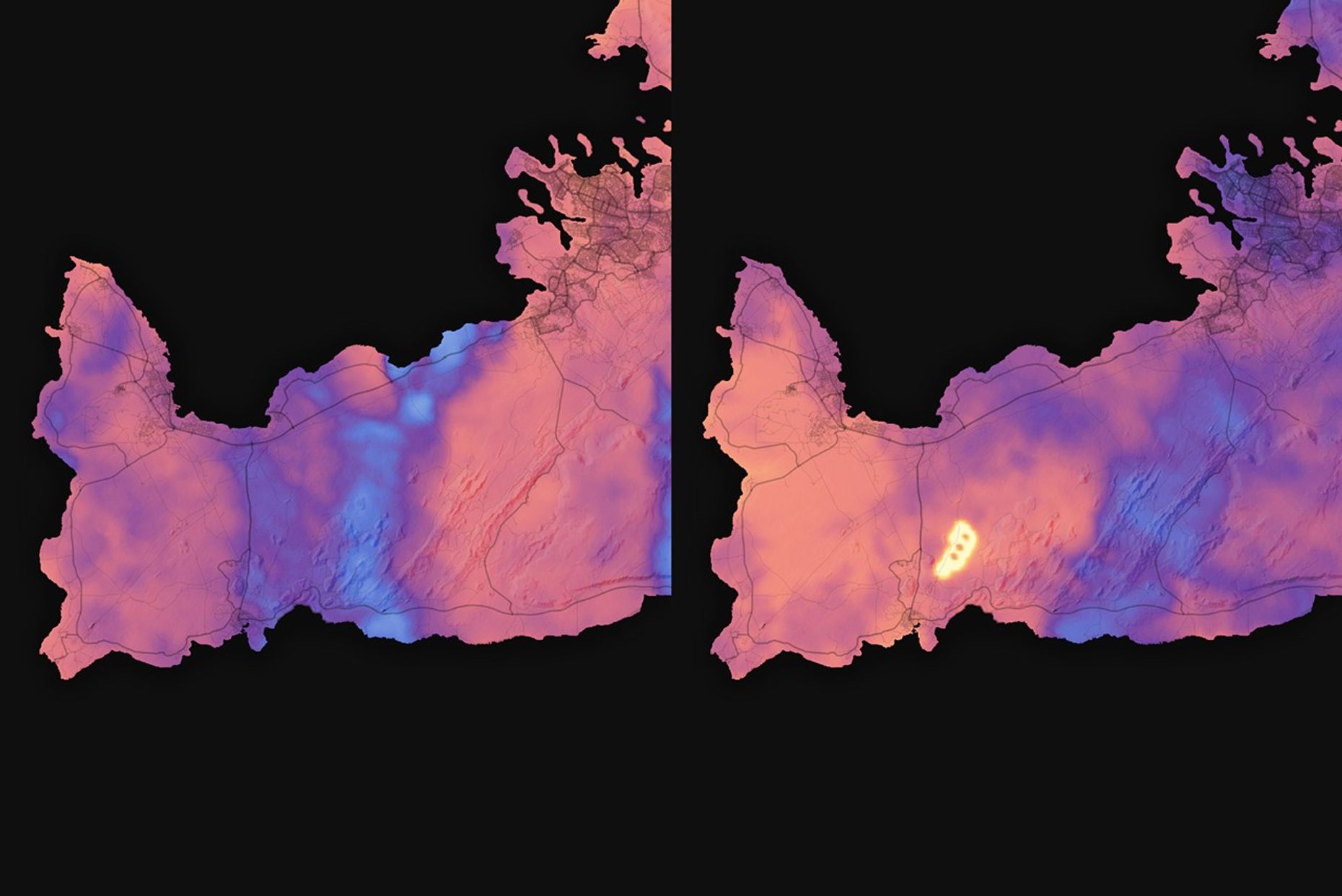
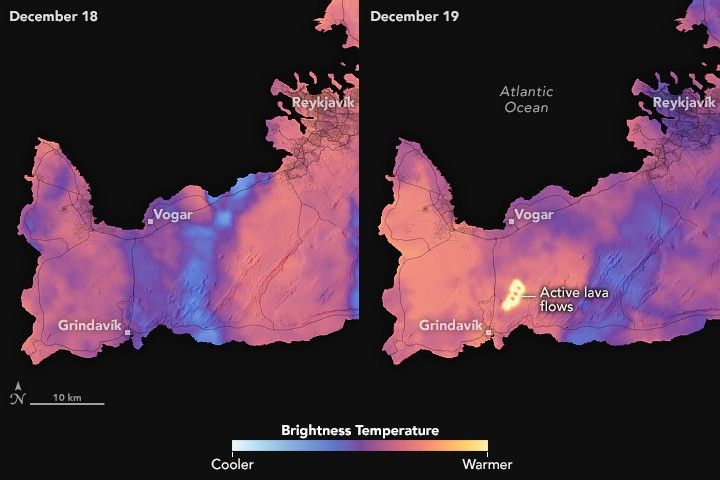
The eruption began with fountains of lava shooting dozens of meters into the air along a 4-kilometer fissure and flowing laterally from five vents. The brightness temperature image above (right) was acquired by the VIIRS (Visible Infrared Imaging Radiometer Suite) on the NOAA-20 satellite at 4:00 a.m. local time on December 19, after the eruption had begun. The other image (left) shows the same area early on December 18, before the eruption. Brightness temperature measurements are useful for distinguishing the relative warmth or coolness of features on the land surface and in the atmosphere.
“What you’re seeing in these images is the very high temperatures of the active lava flows compared to the surrounding land and clouds,” said Simon Carn, a volcanologist at Michigan Technological University. “The darker lower-temperature areas appear to be some topography that the lava is flowing around, but these could also be areas where the eruption fissure is not active and has cooler lava, or where gas plumes or clouds are obscuring the surface.” Topographic maps of the area show three hills to the west of the eruption fissure that reach heights of roughly 200 meters.
Reports from the Icelandic Met Office indicate that lava is mostly flowing east and north, which poses minimal risks to Grindavík, the Blue Lagoon, and other nearby infrastructure. “However, this could change if the lava accumulates and starts flowing in different directions, if the active fissure extends southward, or if new fissures open up," Carn said. "If lava continues to flow north, it could eventually reach the key main road from Keflavík airport to Reykjavík."
Icelandic authorities have emphasized the type of eruption that is occurring—a fissure eruption—does not usually result in large explosions or significant production of ash lofted high into the atmosphere. As of December 19, there were no disruptions to flights to and from Iceland, and international flight corridors remained open, according to Icelandic officials. Officials also noted that the nearby town of Grindavík was evacuated on November 10 as a precaution, and that the current eruption does not present a threat to life.
References & Resources
- Carn, S. via X (2023, December 19) An eruption has started on Iceland’s Reykjanes peninsula. Accessed December 19, 2023.
- Discover (2023, December 18) After Weeks of Waiting An Eruption Has Finally Started in Iceland. Accessed December 19, 2023.
- Government of Iceland (2023, December 19) Reykjanes Volcanic Eruption: Icelandic Government Advice. Accessed December 19, 2023.
- Global Volcanism Program (2023) Reykjanes. Accessed December 19, 2023.
- Iceland Monitor (2023, December 19) Another Tongue-Twister from Iceland’s Newest Volcanic Eruption. Accessed December 19, 2023.
- Icelandic Met Office (2023, December 19) The eruption is focused on five vents. Accessed December 19, 2023.
- NASA Earthdata (2021) Earthquakes and Volcanoes Data Pathfinder. Accessed December 19, 2023.
- Poland, M. et al. (2020) Forecasting, Detecting, and Tracking Volcanic Eruptions from Space. Remote Sensing in Earth Systems Sciences, 3, 55-94.
NASA Earth Observatory image by Michala Garrison, using VIIRS data from NASA EOSDIS LANCE , GIBS/Worldview , and the Joint Polar Satellite System (JPSS). Story by Adam Voiland .