

















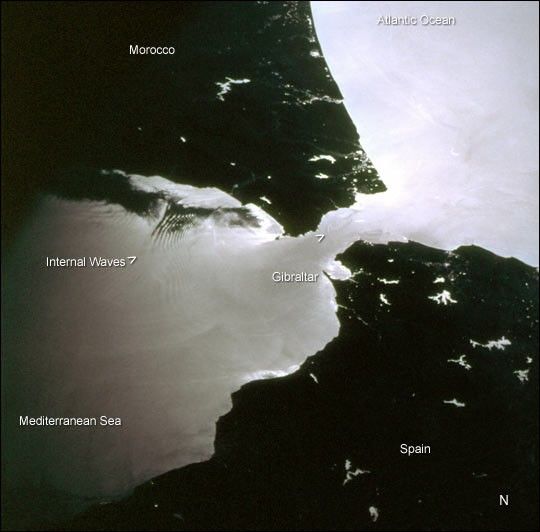
This photograph was taken by the STS-98 astronaut crew as they passedover the western Mediterranean region near sunset on February 19, 2001.Two packets of tidally-generated internal waves are highlighted by sunglinting off the surface waters in the Strait of Gibraltar. The olderpacket (labeled) contains at least 14 waves, which can be counted liketree rings. A younger group is forming near the middle of the strait(marked by the carat south of Gibraltar). The waves are generated as adiurnal tidal pulse flows over the shallow Camarinal Sill at Gibraltar.The waves flow eastward, refract around coastal features; can be tracedfor as much as 150 km, and sometimes create interference patterns withrefracted waves.
Surface water patterns can be observed by astronauts in low-Earthorbit in the sunglint: the sun reflects and is differentially scatteredoff the water surface. The strength of the reflection is determined bythe surfactant layer, which can dampen capillary waves and change thesurface texture of the water. Different types of near-surface waterstructures act to locally concentrate or thin the surfactant layer,which, depending on the instantaneous geometry of the Sun, the Earth andthe spacecraft, show up as brighter and darker regions on the water.Although sunglint effectively masks true water color, the sunglintpatterns reveal surface water dynamics like eddies, current boundariesand even deeper water features like internal waves that are otherwiseinvisible. Sunglint also effectively traces land-water boundaries. Thebright regions in Spain and Morocco are reservoirs, rivers andlakes.
References & Resources
Image number STS098-712-29. Images provided by the Earth Sciences and Image Analysis Laboratory, Johnson Space Center. Additional images taken by astronauts can be viewed at NASA-JSC's Gateway to Astronaut Photography of Earth
None