


















Where the borders of Egypt, Sudan, and Libya meet, a rugged mountain complex rises from the Sahara. The peaks of Jebel Uweinat reach elevations about 2,000 meters (7,000 feet) above sea level. Geologists exploring Jebel Uweinat have found rock layers that are hundreds of millions of years old, preserving traces of landscapes that were very different from the bone-dry environment that prevails here today.
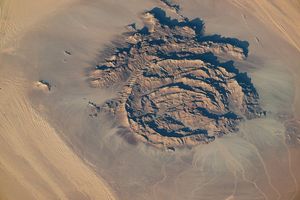
The Advanced Spaceborne Thermal Emission and Reflection Radiometer (ASTER) on NASA’s Terra satellite acquired this image of Jebel Uweinat on March 17, 2010. ASTER combines infrared, red, and green wavelengths of light to make false-color images. Vegetation appears red, and bare ground and rocks appear earth-toned. Because vegetation is so sparse and bare rock is so abundant, this image appears quite similar to a natural-color image.
From ASTER’s perspective, Jebel Uweinat looks like two different structures pushed together. The disparate contours of the eastern and western halves reflect different compositions of the rocks making up the mountain complex. Rocks in the western half were formed by volcanic activity, making a giant ring around a crater. Rocks in the eastern half include sandstone, siltstone, and shale that preserve fossilized clues to past environments when the landscape was flowing with water. Ancient marine organisms burrowed into sediments that later hardened into rock; their burrow tunnels were preserved to the present day.
Today water is scare at Jebel Uweinat, as the surrounding desert receives less than 100 millimeters (4 inches) of rainfall per year. The mountain complex receives just a little more rainfall than the surrounding sand seas. Fewer than 100 species of plants have been recorded here, and some peaks have hardly any plant life. What plants manage to eke out an existence here are generally confined to temporary rivers, or wadis, formed from rainwater runoff.
Jebel Uweinat also holds clues to human habitation in this region, including engraved petroglyphs of giraffes, gazelles, lions, ostriches, and people.
NASA Earth Observatory image by Jesse Allen and Robert Simmon, using data from NASA/GSFC/METI/ERSDAC/JAROS, and U.S./Japan ASTER Science Team. Caption by Michon Scott.