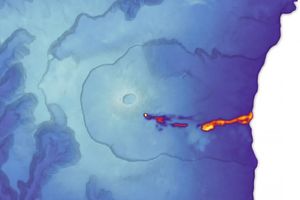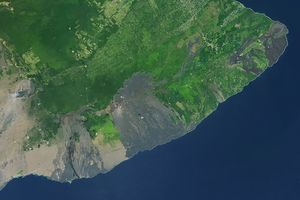
















Kilauea continues to earn its reputation as Earth’s most active volcano. Since January 1983, Kilauea has coated much of the southeast coast of Hawaii in fresh lava. The center of the eruption is Pu’u O’o—a crater southeast of Kilauea’s summit. During May and June 2012, fresh lava emerged at Pu’u O’o, then traveled through lava tubes down Kilauea’s steep slopes. The lava emerged on the pali (a Hawaiian word for cliff) and on the coastal plain, further down the mountainside.
This natural-color image was acquired by the Advanced Land Imager (ALI) aboard the Earth Observing-1 (EO-1) satellite on June 12, 2012. Red areas are hotspots in ALI’s shortwave infrared band. They indicate either fluid or recently hardened lava, still hot enough to “glow” in infrared light. Hotspots are apparent at lava breakouts near the coast, and at the lava lake that currently fills Pu’u O’o.
References & Resources
- USGS. 2012, June 13. Recent Kilauea Status Reports, Updates, and Information Releases. Accessed June 13, 2012.
NASA images by Jesse Allen and Robert Simmon using EO-1 ALI data. Caption by Robert Simmon.