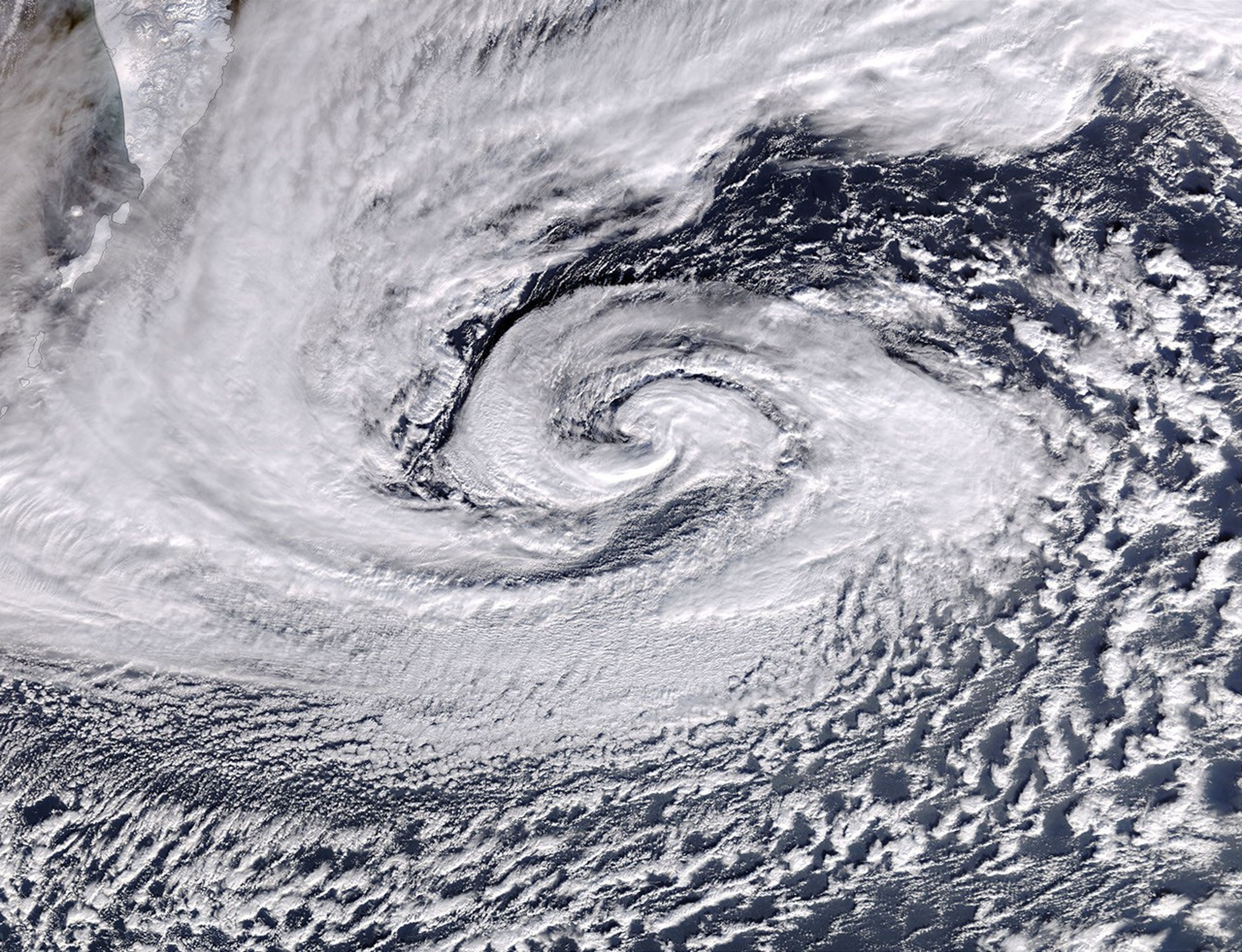






















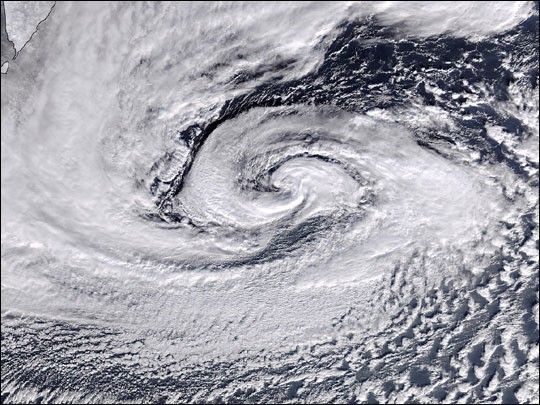
On December 12, 2002, a strong low-pressure system could be seen whirling away just south of Kamchatka Peninsula and the Aleutian Islands in the northwestern Pacific. The above true-color image of the low-pressure system was acquired by the Moderate Resolution Imaging Spectroradiometer (MODIS) instrument, flying aboard NASA’s Terra spacecraft. The tip of the peninsula can be seen in the upper left-hand corner of the image.
Generally, high- and low-pressure systems form when air mass and temperature differences between the surface of the Earth and the upper atmosphere create vertical currents. In a low-pressure system, these vertical winds travel upwards and suck air away from the surface of the Earth like a giant vacuum cleaner, decreasing the air pressure above the ground or sea. This decrease in surface air pressure in turn causes atmospheric currents moving parallel to the surface of the Earth near the base of the low to spin counter clockwise (clockwise in the Southern Hemisphere). Lows function like giant slow-moving hurricanes. The lower in pressure a low-pressure system gets, the more robust and larger this spinning circulation pattern becomes.
References & Resources
Image courtesy Jacques Descloitres, MODIS Rapid Response Team, NASA GSFC