

The fragile and rapidly changing Arctic is home to large reservoirs of methane, a potent greenhouse gas. As Earth’s climate warms, that methane is vulnerable to possible release into the atmosphere, where it can add to global warming.
Researchers have known for years that large amounts of methane are frozen in Arctic tundra soils and in marine sediments (including gas hydrates). But now a multi-institutional study led by Eric Kort—now at NASA’s Jet Propulsion Laboratory after conducting the research at Harvard University—has uncovered a surprising and potentially important source of methane: the Arctic Ocean itself.
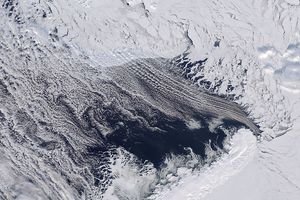
The photograph above was taken by Kort, and it shows leads and cracks in the ice cover of the Arctic Ocean north of Alaska. During five research flights in 2009–10, Kort and colleagues measured increased methane levels while flying at low altitudes north of the Chukchi and Beaufort Seas in a National Science Foundation/National Center for Atmospheric Research (NCAR) Gulfstream V aircraft as part of the HIAPER Pole-to-Pole Observations (HIPPO) airborne campaign.
The methane level detected during the flights was about one-half percent higher than normal background levels.— But where was the methane coming from? The team detected no excess carbon monoxide in the atmosphere, which would have been a signature of methane coming from the human combustion of fuels. And based on the time of year, the location, and the nature of the emissions, it was unlikely that the methane was coming from high-latitude wetlands or geologic reservoirs.
By comparing the locations of the enhanced methane levels with airborne measurements of carbon monoxide, water vapor, and ozone, the researchers from six institutions pinpointed a source: the ocean surface, in places where there were cracks and openings in the sea ice cover. The cracks were allowing methane in the top layers of the sea to escape into the atmosphere. The team did not detect enhanced methane levels over areas of solid ice.
Kort noted that previous studies had detected high concentrations of methane in Arctic surface waters, but no one had predicted that this dissolved methane would find its way into the overlying atmosphere. Scientists are not yet sure how the methane is produced, but Kort suspects biological productivity in Arctic surface waters may be the culprit.
“While the methane levels we detected weren't particularly large, the potential source region, the Arctic Ocean, is vast,” he said. “Our finding could represent a noticeable new global source of methane.”
References & Resources
- Kort, E.A., et al (2012) Atmospheric observations of Arctic Ocean methane emissions up to 82ð north. Nature Geoscience 5, 318—321.
Courtesy Eric Kort, Jet Propulsion Laboratory. Caption based on a text by Alan Buis, JPL. The research was funded by the National Science Foundation, with additional support from the National Center for Atmospheric Research, NASA, and the National Oceanic and Atmospheric Administration.