










NASA satellite data suggest that for more than two decades there’s been a gradual greening of the northern latitudes of Earth.
Researchers confirm that plant life seen above 40 degrees north latitude, which represents a line stretching from New York to Madrid to Beijing, has been growing more vigorously since 1981. One suspected cause is rising temperatures possibly linked to the buildup of greenhouse gases in our atmosphere.
Over this same time period, parts of the Northern Hemisphere have become much greener and the growing season has increased by several days. Further, Eurasia appears to be greening more than North America, with more lush vegetation for longer periods of time.
“When we looked at temperature and satellite vegetation data, we saw that year-to-year changes in growth and duration of the growing season of northern vegetation are tightly linked to year-to-year changes in temperature,” Liming Zhou of Boston University said. The area of vegetation has not extended, but the existing vegetation has increased in density.
The greenness data from satellites were strongly correlated with temperature data from thousands of meteorological stations on both continents. The Eurasian greening was especially persistent over a broad area from central Europe through Siberia to far-east Russia, where most of the vegetation is forests and woodlands. North America, in comparison, shows a fragmented pattern of change notable only in the forests of the East and grasslands of the upper Midwest.
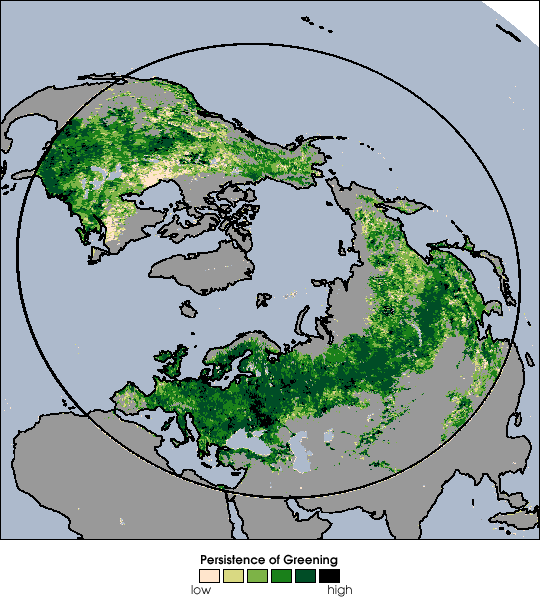
This view of the top of the world shows enhanced plant growth over the last 20 years, from the north pole, stretching southward to the 30° North latitude line (the circle).
The color key represents changes in vegetation lushness of the past 20 years. It ranges from a low increase in the heartiness of vegetation as denoted by the beigecolor, to the highest increase in the lushness of plants as denoted by dark green and black colors.
For more information, read: Earth’S Becoming a Greener Greenhouse and Measuring Vegetation (NDVI & EVI)
References & Resources
Image courtesy Liming Zhou, Boston University
None