














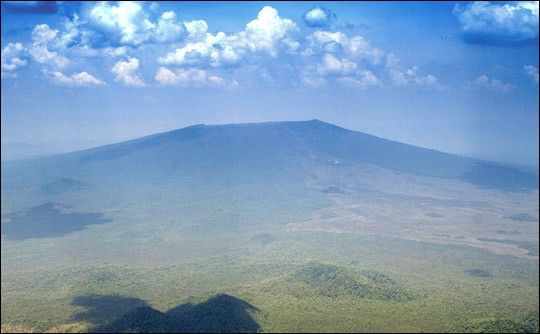
Nyamuragira Volcano (also known as Nyamulagira), in eastern Democratic Republic of the Congo, ranks among Africa’s most active volcanoes. After a month of unrest, Nyamuragira erupted on November 27, 2006, and scientists at the nearby Goma Volcano Observatory were concerned that the local population could be in danger.
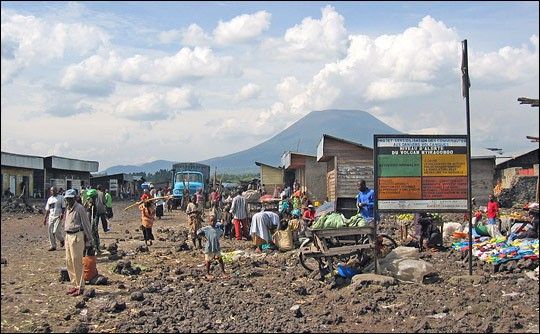
They had good reason to worry; in January 2002, neighboring Nyiragongo Volcano had erupted, sending a river of molten rock through the town of Goma and into nearby Lake Kivu. According to some estimates, that disaster had killed more than a hundred people and displaced a quarter million.
At the onset of the November 2006 eruption, volcanologists watching the distant glow in the nighttime sky knew that Nyamuragira produced fast-flowing lava. If it flowed very far, it might reach the nearby town of Sake, perhaps mimicking the 2002 nightmare. Years of civil war, however, had left the country with lingering strife and few disaster-response resources. To reach the volcano, scientists would have had to risk not just lava but sniper fire.
On December 1, 2006, the international science community received an appeal for assistance from the scientists at the Goma Observatory asking for any satellite imagery that could help them safely monitor the situation. One of the scientists who fielded this appeal was Ashley Davies, a research scientist at NASA’s Jet Propulsion Laboratory (JPL).
Davies is part of NASA’s Volcano Sensor Web, an experimental artificial intelligence (AI) project that links orbiting and ground-based volcanic sensors with NASA’s Earth Observing-1 satellite. When the satellite receives an alert of a volcanic trouble spot, it can change its data collection and transmission plans accordingly, without waiting for a human command. The Sensor Web is an offshoot of the lab’s Autonomous Sciencecraft Experiment, a broader effort to test advanced software and AI technology that could network space exploration assets—satellites, orbiters, and rovers—and make them more self-directed.
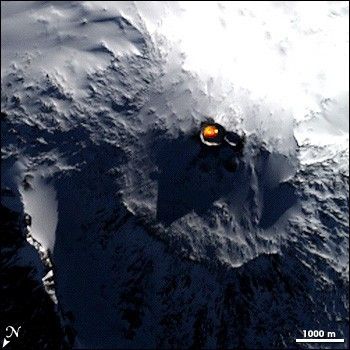
In 2004, the Earth Observing-1 (EO-1) satellite had first demonstrated its abilities by detecting and self-directing observations of an eruption of remote Erebus Volcano in Antarctica and delivering data to scientists within hours. “It worked perfectly,” Davies recalls, “although human lives weren’t at stake in that situation.”
In contrast, when Nyamuragira erupted in late 2006, Davies understood that human lives could be in jeopardy. “I immediately picked up the phone and started to do the human thing and call the person who manually handles spacecraft ops for EO-1 to re-task it,” he says. “And then I noticed this email from the sensor web system. The planning software at JPL had picked up an alert originating from the Volcanic Ash Advisory Center in Toulouse [France], and had already re-tasked the spacecraft to get the data.”
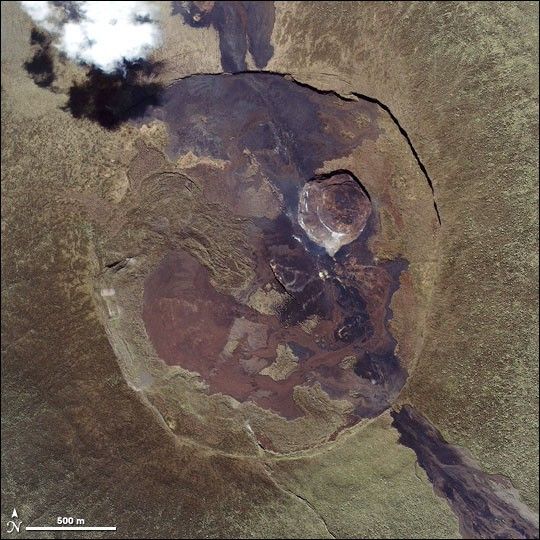
A step ahead of him, the sensor web had given EO-1 new orders to observe Nyamuragira Volcano at the next available opportunity, on December 4, 2006. The system transmitted a preview of the data to JPL on December 4, showing the intense thermal emission characteristic of ongoing volcanic activity. Complete high-resolution images and thermal data pinpointing the location of vent and lava flows arrived on December 5. By this time, EO-1 had re-tasked itself to obtain more data on December 7.
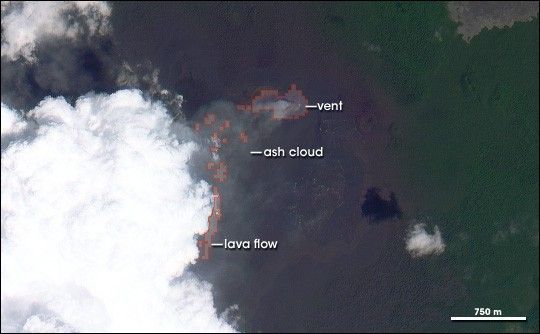
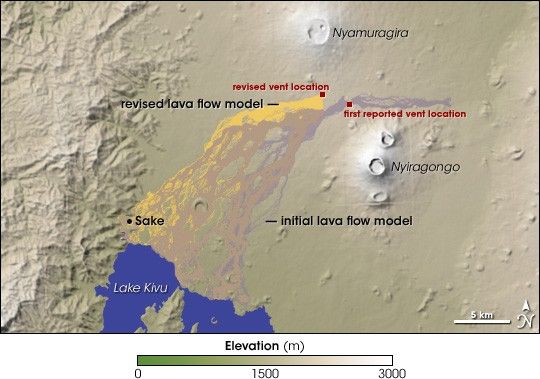
The December 4 data led scientists to revise their prediction of where the lava would flow. Based on the best estimate of the vent location from staff at the Goma Observatory, models run by geologist Paolo Papale and his colleagues at the L’Istituto Nazionale di Geofisica e Volcanologia (INGV) in Italy initially predicted that lava would flow both to the east and to the southwest, toward the town of Sake. The estimate for the vent location, however, was off by about 2 kilometers.
Improving the Sensor Web
The Volcano Sensor Web proved its value in disaster planning, but the process still required some human involvement. After the satellite transmitted the images and thermal data, Davies had to produce maps to send to his colleagues. “It was all done in about 30 minutes,” he recalls, but in the future, even map production and delivery will be automated.
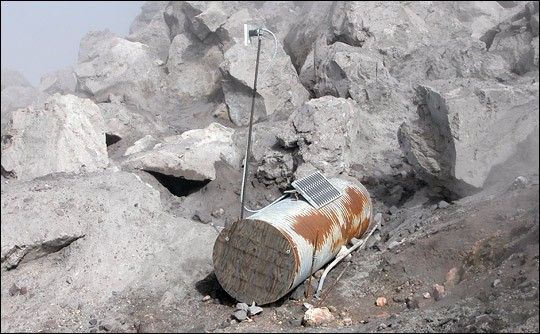
Davies is also working with scientists at the Hawaiian Volcano Observatory and Mt. Erebus Volcano Observatory to build more model data into the sensor web system, allowing it to be triggered not just by ongoing eruptions but also by precursors to eruptions. “When magma moves up from depth in a volcano, the volcano bulges,” he explains. Ground-based tilt meters that measure changes in slope steepness could detect these bulges and trigger a satellite observation.
Besides planning future refinements to Earth-based autonomous systems, Davies looks beyond our home planet to envision how they might work elsewhere. “Mars is a good example,” he says. “We’re looking at a time in the future when there are multiple assets [orbiters, rovers], and they can communicate with each other. A smart system can help maximize the resource usage and data return. There’s also the safety aspect. Something in orbit could detect a storm moving in, and it could warn assets on the ground to hunker down for the duration."
Picturing sensor webs on other planets comes naturally to Davies, who took a circuitous route to watching Nyamuragira. Long before he monitored Earth’s volcanoes, he studied volcanoes a little more remote—over 600 million kilometers away, on Jupiter’s moon Io. Scientists didn’t even know Io’s volcanoes existed before 1979, when NASA’s Voyager 1 spacecraft provided a revolutionary view of the moon.
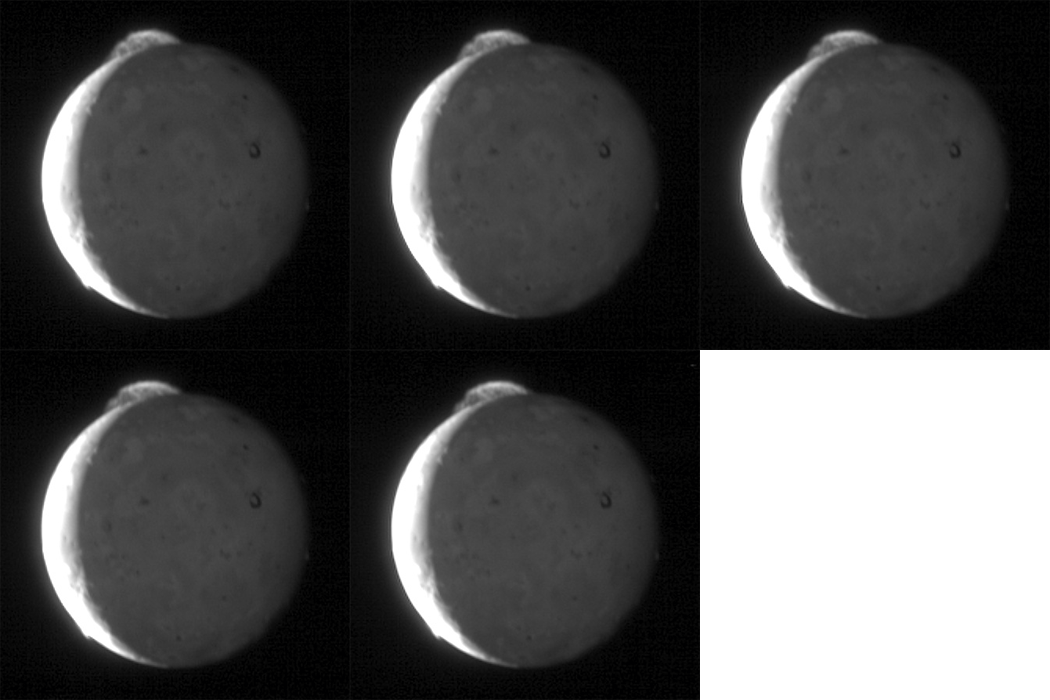
"One of the great discoveries of planetary science was the detection of these huge, hot volcanoes,” Davies remarks. “Up to that point, it was thought that all the moons of the outer planets were just these little, cold, dead ice balls.” Figuring out how to study this distant moon drew Davies to the Autonomous Sciencecraft Experiment, which uses Earth as an analog for remotely observing other worlds. “When they came to me and asked, ‘What would you like to look at [with the sensor web]?’ I said ‘Volcanoes, of course!’”
His fascination with Io continues, helped by his Earth-based observations. He has just published a book comparing volcanic activity on the two worlds. Yet despite his fundamental interest in distant moons, Davies takes considerable pleasure in his success here on Earth.
“The folks on the ground were delighted with the Nyamuragira data,” he says. He estimates that the Volcano Sensor Web had autonomously tasked itself to take observations hundreds of times before. “But this was the first time where the system demonstrated a vastly superior response to the normal way of doing business. There have been proof-of-concept successes in the past but nothing quite like this."
References
- Davies, A., Wright, R., Kyle, P., Castaño, R., Chien, S., Tran, D., Chadde, S., Mandrake, L., Mandl, D., and Frye, S. (2007). A science model-driven autonomous volcano sensor web. NASA Science Technology Conference 2007, Paper D3P2.
- Davies, A.G. (2007). Volcanism on Io. Cambridge University Press, Cambridge, England.
- Incorporated Research Institutions for Seismology. (2002, January 21). Nyiragongo Volcano, Democratic Republic of Congo. Accessed December 3, 2007.
- NASA. (2003, October 6). Jupiter: Moons: Io. Accessed December 3, 2007.
- NASA Earth Observatory. (2006, December 6). Eruption of Mount Nyamulagira (Nyamuragira). Accessed December 3, 2007.
- NASA Goddard Space Flight Center. Earth Observing-1. Accessed December 3, 2007.
- NASA Jet Propulsion Laboratory. (2007, August 10). Autonomous Sciencecraft Experiment. Accessed December 3, 2007.
- NASA Jet Propulsion Laboratory. (2007, June 28). Volcano Sensorweb. Accessed December 3, 2007.
NASA Earth Observatory story by Michon Scott; design by Robert Simmon