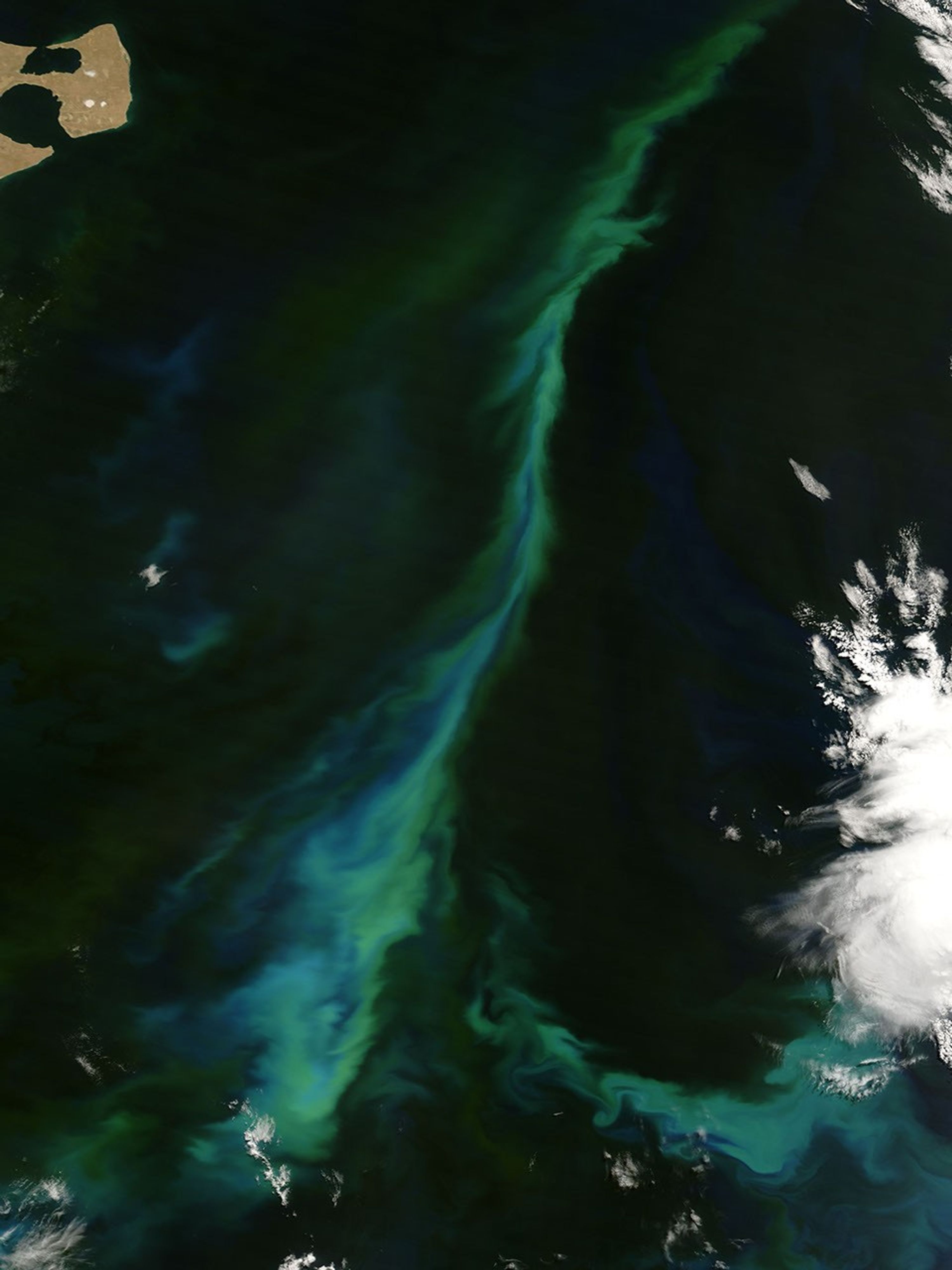














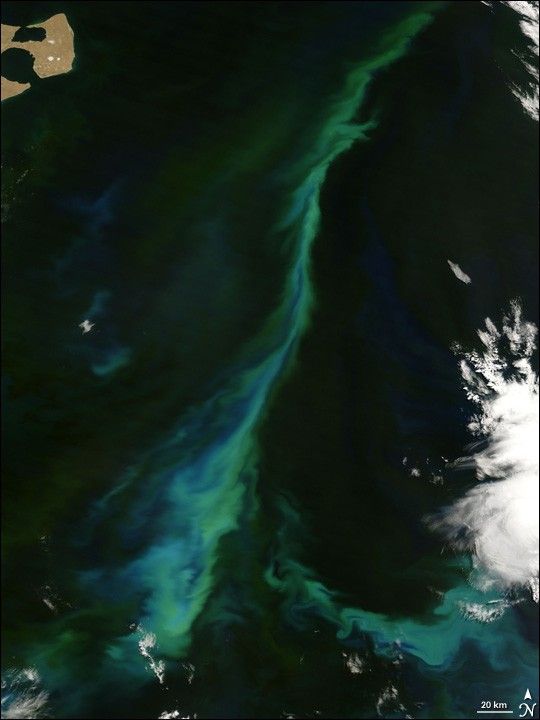
The Atlantic Ocean was awash with color on December 18, 2006, when the Moderate Resolution Imaging Spectroradiometer (MODIS) on NASA’s Terra satellite captured this image. The brilliant greens and blues are densely concentrated, microscopic plants growing on the surface of the ocean. Called phytoplankton, the plants thrive in the cool, nutrient-rich waters off the coast of Argentina. Here, the Malvinas (Falkland) Current sweeps north from the frigid Southern Ocean along the shallow continental shelf. The interaction of the current with the edge of the shelf pulls nutrients from the shelf floor to the surface, and this provides the “fertilizer” needed to drive plant growth. The resulting bloom stretches in a long, thin line along the continental shelf.
Because phytoplankton sit at the base of the marine food chain, the parts of the ocean that support large blooms tend to have a large and diverse population of fish and other animals. Phytoplankton also play an important role in the global carbon cycle. Like all plants, phytoplankton soak up carbon dioxide, providing a crucial sink for the greenhouse gas. Rising ocean temperatures in the past decade have caused global phytoplankton productivity to decline, though some evidence suggests that productivity in the South Atlantic off Argentina may be increasing.
The high-resolution image provided above is at MODIS’ full spatial resolution (level of detail) of 250 meters per pixel. The MODIS Rapid Response System provides this image at additional resolutions.
You can also download a 250-meter-resolution KMZ file for use with Google Earth.
References & Resources
Image courtesy Jeff Schmaltz, MODIS Rapid Response Team at NASA GSFC