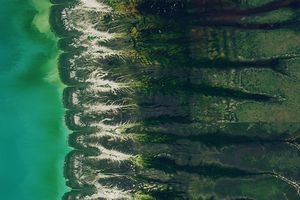
























A streak of blue across the mouth of Shark Bay in Western Australia probably points to the presence of phytoplankton in the water. These microscopic plants reflect light, making the ocean surface appear bright blue. A phytoplankton bloom such as this is not surprising: Shark Bay teems with life. The 2.5-million hectare bay has been placed on the World Heritage list partly because of its biological diversity, and phytoplankton is the most basic form of food for marine animals. The streak could also be caused by sediment resuspended from the shallow bay floor. Like phytoplankton, sediment reflects light and can tint the water a brilliant blue.
Other marine vegetation may be visible in this image. Protected from the rough Indian Ocean, vast meadows of seagrass grow in the clear, shallow waters of Shark Bay. The plants may give the waters of the bay the dark green tint seen along the shores. Again, sediment may also contribute to the coloring of the water near the shore. The Moderate Resolution Imaging Spectroradiometer (MODIS) on NASAâs Terra satellite captured this image on November 6, 2004.
References & Resources
NASA image courtesy Jeff Schmaltz, MODIS Land Rapid Response Team at NASA GSFC