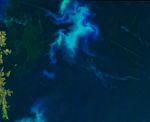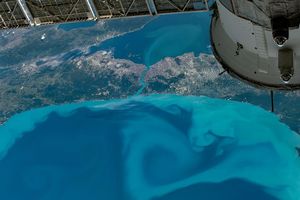


















As daylight grows in the Northern Hemisphere, phytoplankton are responding. In mid-June 2016, a colorful bloom of these microscopic, plant-like organisms was visible in the North Sea, east of the Shetland Islands. The Operational Land Imager (OLI) on Landsat 8 acquired this natural-color image of the bloom on June 12, 2016.
One day later, the Moderate Resolution Imaging Spectroradiometer (MODIS) instrument on NASA’s Aqua acquired an image that shows the broader area covered by the bloom.
Spring blooms are common here, and also in areas of the North Atlantic west of this image. That’s where scientists with the North Atlantic Aerosols and Marine Ecosystems Study (NAAMES) set out earlier this spring to study the largest bloom on the planet. In large numbers, these tiny organisms are important for the marine food chain and also play a role in local and global climate.
References & Resources
NASA Earth Observatory image by Joshua Stevens, using Landsat data from the U.S. Geological Survey . Caption by Kathryn Hansen.