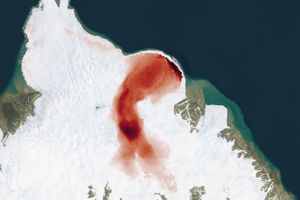





















This pair of Multi-angle Imaging Spectroradiometer (MISR) images of the Pine Island Glacier in westernAntarctica was acquired on December 12, 2000 during Terra orbit 5246. Atleft is a conventional, true-color image from the downward-looking(nadir) camera. The false-color image at right is a composite of redband data taken by the MISR forward 60-degree, nadir, and aftward60-degree cameras, displayed in red, green, and blue colors,respectively. Color variations in the left (true-color) image highlightspectral differences. In the multi-angle composite, on the other hand,color variations act as a proxy for differences in the angularreflectance properties of the scene. In this representation, clouds showup as light purple. Blue to orange gradations on the surface indicate atransition in ice texture from smooth to rough. For example, the brightorange 'carrot-like' features are rough crevasses on the glacier'stongue. In the conventional nadir view, the blue ice labeled 'roughcrevasses' and 'smooth blue ice' exhibit similar coloration, but themulti-angle composite reveals their different textures, with thesmoother ice appearing dark purple instead of orange. This could be anindicator of different mechanisms by which this ice is exposed. Themulti-angle view also reveals subtle roughness variations on the frozensea ice between the glacier and the open water in Pine Island Bay.
To the left of the 'icebergs' label are chunks of floating ice.Additionally, smaller icebergs embedded in the frozen sea ice arevisible below and to the right of the label. These small icebergs areassociated with dark streaks. Analysis of the illumination geometrysuggests that these streaks are surface features, not shadows. Wind-driven motion and thinning of the sea ice in the vicinity of theicebergs is one possible explanation.
Recently, Robert Bindschadler, a glaciologist at the NASA Goddard SpaceFlight Center discovered in Landsat 7 imagery a newly-formed cracktraversing the Pine Island Glacier. This crack is visible as anoff-vertical dark line in the MISR nadir view. In the multi-anglecomposite, the crack and other stress fractures show up very clearly inbright orange. Radar observations of Pine Island Glacier in the 1990'sshowed the glacier to be shrinking, and the newly discovered crack isexpected to eventually lead to the calving of a major iceberg.
References & Resources
Image courtesy NASA/JPL/GSFC/LaRC, MISR Team