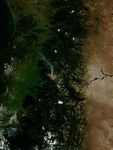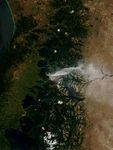





























The eruption at the Puyehue Cordón Caulle Volcanic Complex, which began in June 2011, may finally be waning. A satellite image collected on March 7, 2012, (above, top) shows a relatively small and diffuse ash plume. At the time, SERNAGEOMIN (the Chilean National Service of Geology and Mining) reported that the plume was 1.2 kilometers (3,900 feet) high, and extended 30 kilometers (19 miles) from the active vent. About a month before—on February 10th—the plume was longer, wider, and thicker (above, lower).
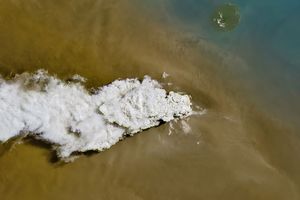
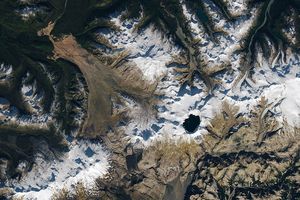
These natural-color images were acquired by the Moderate Resolution Imaging Spectroradiometer (MODIS) on the Terra (March 7) and Aqua (February 10) satellites. In addition to the ash plume, widespread effects of the eruption are visible. Immediately to the east of the summit complex, thick ash fall killed much of the vegetation, leaving the area dark brown. Further to the east is a string of turquoise lakes, the bright color caused by fine ash suspended in the water. Southwest of the volcano, Lago Puyehue is partially covered with floating pumice. The ash is detrimental to local agriculture, suppressing crop yields and damaging pastures.
References & Resources
- Nature News Blog. (2012, February 12). Chilean volcano’s ash is still disrupting ecosystems. Accessed March 9, 2012.
- SERNAGEOMIN. (2012, March 7). Reporte Especial Actividad Volcánica N°321. (PDF). Accessed March 9, 2012.
NASA images courtesy Jeff Schmaltz, LANCE/EOSDIS MODIS Rapid Response Team. Caption by Robert Simmon.