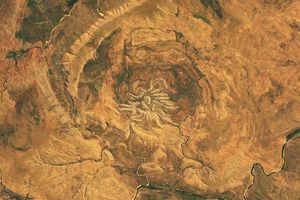



























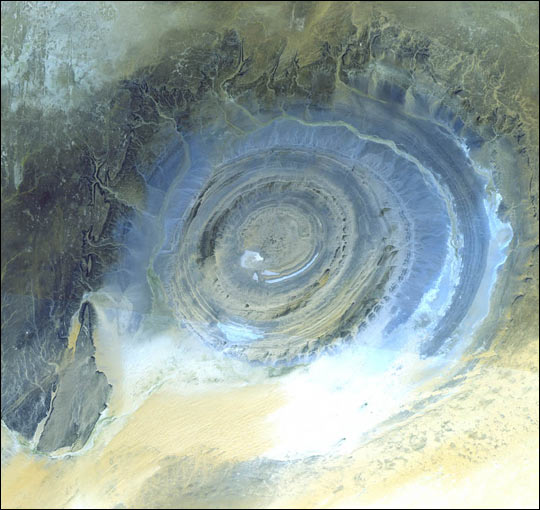
This prominent circular feature in the Sahara desert of Mauritania hasattracted attention since the earliest space missions because it forms aconspicuous bull’s-eye in the otherwise rather featureless expanse of thedesert. Described by some as looking like an outsized ammonite in the desert,the structure [which has a diameter of almost 50 kilometers (30 miles)] hasbecome a landmark for shuttle crews. Initially interpreted as a meteorite impactstructure because of its high degree of circularity, it is now thought to bemerely a symmetrical uplift (circular anticline) that has been laid bare byerosion. Paleozoic quartzites form the resistant beds outlining the structure.
This image was acquired on October 7, 2000 by the Advanced Spaceborne ThermalEmission and Reflection Radiometer (ASTER) on NASA’s Terra satellite. Withits 14 spectral bands from the visible to the thermal infrared wavelengthregion, and its high spatial resolution of 15 to 90 meters (about 50 to 300feet), ASTER will image Earth for the next 6 years to map and monitor thechanging surface of our planet.
References & Resources
Image courtesy NASA/GSFC/MITI/ERSDAC/JAROS, and U.S./Japan ASTER Science Team