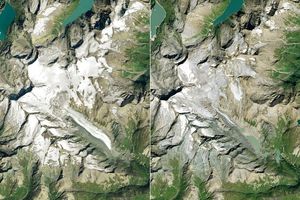





















On September 20, in the Caucasus Mountains, the collapse of a hanging glacier from the slope of Mt. Dzhimarai-Khokh onto the Kolka Glacier below triggered an avalanche of ice and debris. The debris slid more than 15 miles (24 km). The avalanche buried small villages in the Russian Republic of North Ossetia, killing dozens of people.
The source of the avalanche can be seen at lower left, at the starting point of a long line of grayish avalanche debris standing out against the bright snow and ice. The debris flow (grayish line running through image center) plugged up the mouth of other rivers and is creating flooding. Notice the bright blue-green lake being created behind the large grayish mass of avalanche debris in the top center of the image.
This image of the region was captured on October 6, 2002, by the Advanced Land Imager instrument on the EO-1 spacecraft.
References & Resources
Image by Jesse Allen, based on data provided by Lawrence Ong, EO-1 Mission Office.