

















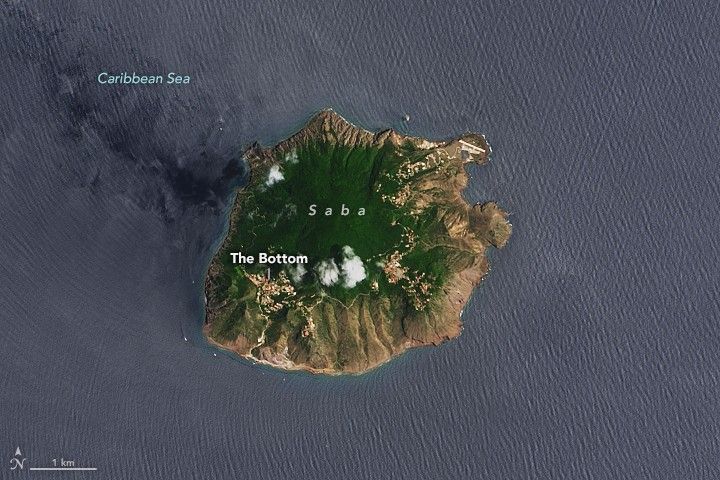
Saba is a 13-square-kilometer (5-square-mile) island in the Dutch Caribbean rich in biodiversity. Located about 140 kilometers east of the U.S. Virgin Islands, the active stratovolcano rises 1,500 meters above the sea floor. Above the water, rainforests cover the steep slopes of the volcano, home to many birds, orchids and reptiles, including an endemic spotted lizard, the Saban anole (Anolus sabensis). Below the water, corals and other species thrive.
The Operational Land Imager (OLI) on Landsat 8 captured this natural-color image of Saba on August 16, 2022. The largest city and the capital city of the island, called The Bottom, lies between the port and the higher elevations of the volcano. The island has no natural sandy beaches which makes it less of a tourist destination than other Caribbean islands, but Saba’s coastal waters have been ideal for divers looking to spot healthy populations of corals and sea urchins.
That is until recently. In early 2022, sea urchins in the Caribbean started mysteriously dying off. Sea urchins graze on algae, the main competitors for corals for space and light, and they remove algae from coral surfaces, allowing baby corals to attach and grow. In this way, the survival of coral reefs depends on healthy populations of sea urchins.
In early February 2022, dive shops in the Caribbean began reporting on mysterious sea urchin die offs, specifically the long-spined sea urchin (Diadema antillarum). Saba’s reef was once home to more than 5,000 D. antillarum. But in April 2022, in a section of Saba’s reef called “Diadema City,” half of the long-spined sea urchins died off in just one week, and only 100 remained in June, according to reporting in ScienceNews.
The massive loss of sea urchins is reminiscent of a die-off that started in 1983, in which virtually all of the D. antillarum population in the Caribbean was eliminated within a year. Although the exact cause of the 1983 and 2022 die-offs is still a mystery, many researchers agree that the speed and scope of the event in the 1980s indicates the spread of an unknown disease.
Populations of D. antillarum never fully recovered from the die-off nearly 30 years ago, which incentivized Dutch researchers to cultivate and breed them in the lab. The researchers hope to repopulate the sea urchins in Saba’s surrounding waters, to help the reef bounce back.
References & Resources
- AP News (2022, April 14) Concerned scientists probe sea urchin deaths in Caribbean. Accessed December 6, 2022.
- Knowlton, N. (2001) Sea urchin recovery from mass mortality: New hope for Caribbean coral reefs? Proceedings of the National Academy of Sciences, 98(9), 4822–4824.
- Lessios H. A. (2016) The Great Diadema antillarum Die-Off: 30 Years Later. Annual review of marine science, 8, 267–283.
- Saba News (2022, July 5) Long-spined sea urchins: not trouble but in trouble. Accessed December 6, 2022.
- ScienceNews (2022, September 27) A Caribbean island gets everyone involved in protecting beloved species. Accessed December 6, 2022.
- Smithsonian Institution Saba. Accessed December 6, 2022.
- United Nations Environment Program (UNEP) (2018, October) Mount Scenery National Park. Accessed December 6, 2022.
NASA Earth Observatory image by Allison Nussbaum, using Landsat data from the U.S. Geological Survey . Story by Emily Cassidy .