



















July 17, 2012
Sea Ice Retreats in the Northwest Passage
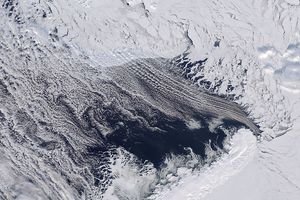
Ice retreated rapidly in the Parry Channel—part of the famous and elusive Northwest Passage—between mid-July and early August 2012.
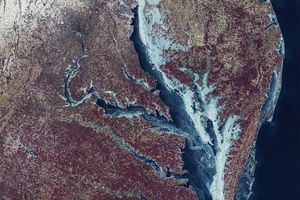
These images, acquired by the Moderate Resolution Imaging Spectroradiometer (MODIS) on NASA’s Terra satellite, show significant changes over two weeks. The top image shows Parry Channel on July 17, 2012, when ice filled the channel. The bottom image shows the same region on August 3, when some ice was still clinging to the shores of Victoria and Melville Islands but open water otherwise dominated the region.
The Canadian Ice Service reported that ice cover in Parry Channel began to fall below the 1981–2010 median after July 16, 2012, and the loss accelerated over the following two weeks. On July 23, the percentage of ice cover in the channel was roughly 67 percent, compared to the median of 80 percent. On July 30, ice cover was roughly 33 percent, compared a median of 79 percent.
These photo-like images show widespread open water in early August, though patches of ice linger south of Melville Island. Walt Meier of the National Snow and Ice Data Center cautioned, however, that while the Parry Channel appeared almost entirely free of ice, it was not necessarily open for navigational purposes. Sea ice can be thin enough to avoid detection by satellite sensors such as MODIS yet still thick enough to impede ships.
Whether or not ships can easily pass, recent studies have suggested that certain organisms have begun to take advantage of the open water. The Northwest Passage opened in 2007, a year when there was record-low sea ice in the Arctic. A 2007 study on Neodenticula seminae—a type of plankton historically found in the Pacific Ocean—concluded that the species had turned up in the North Atlantic. The research suggested that the plankton’s route included the Canadian Arctic Archipelago. A 2012 study on bowhead whales, which tracked individuals with satellite transmitters, indicated that Pacific and Atlantic populations had begun to overlap in the Northwest Passage in August 2010.
Attempts to identify a shortcut between Europe and Asia across the Arctic date back to the late fifteenth century, just several years after Columbus journeyed to the Americas. For centuries, attempts to find the route were stymied by unfamiliar geography and unforgiving ice. The Northwest Passage was first successfully navigated by the Norwegian explorer Roald Amundsen between 1903 and 1906. He used the southern route through the Northwest Passage; Parry Channel is part of the northern or “preferred” route.
Wider views of the Northwest Passage, acquired on August 2, 2012, are available from the NASA Ocean Color Web and the Earth Observatory.
References & Resources
- Canadian Ice Service. (2012, August 6) Animated map of the last 10 days and Weekly ice coverage for the season 2012: Northwest Passage, Parry Channel. Accessed August 6, 2012.
- Heide-Jørgensen, M.P., Laidre, K.L., Quakenbush, L.T., Citta, J.J. (2012) The Northwest Passage opens for bowhead whales. Biology Letters, 8(2), 270–273.
- NASA Goddard Space Flight Center. Ocean Color Web. Accessed August 7, 2012.
- Princeton University Library. Of Maps and Men: In Pursuit of a Northwest Passage. Accessed August 6, 2012.
- Reid, P.C., Johns, D.G., Edwards, M., Starr, M., Poulin, M., Snoeijs, P. (2007) A biological consequence of reducing Arctic ice cover: arrival of the Pacific diatom Neodenticula seminae in the North Atlantic for the first time in 800 000 years. Global Change Biology, 13(9), 1910–1921.
- Roach, J. (2007, September 17) Arctic melt opens Northwest Passage. Accessed August 6, 2012.
NASA Earth Observatory images by Jesse Allen, using data from the Land Atmosphere Near real-time Capability for EOS (LANCE). Caption by Michon Scott, with information from Walt Meier, National Snow and Ice Data Center.