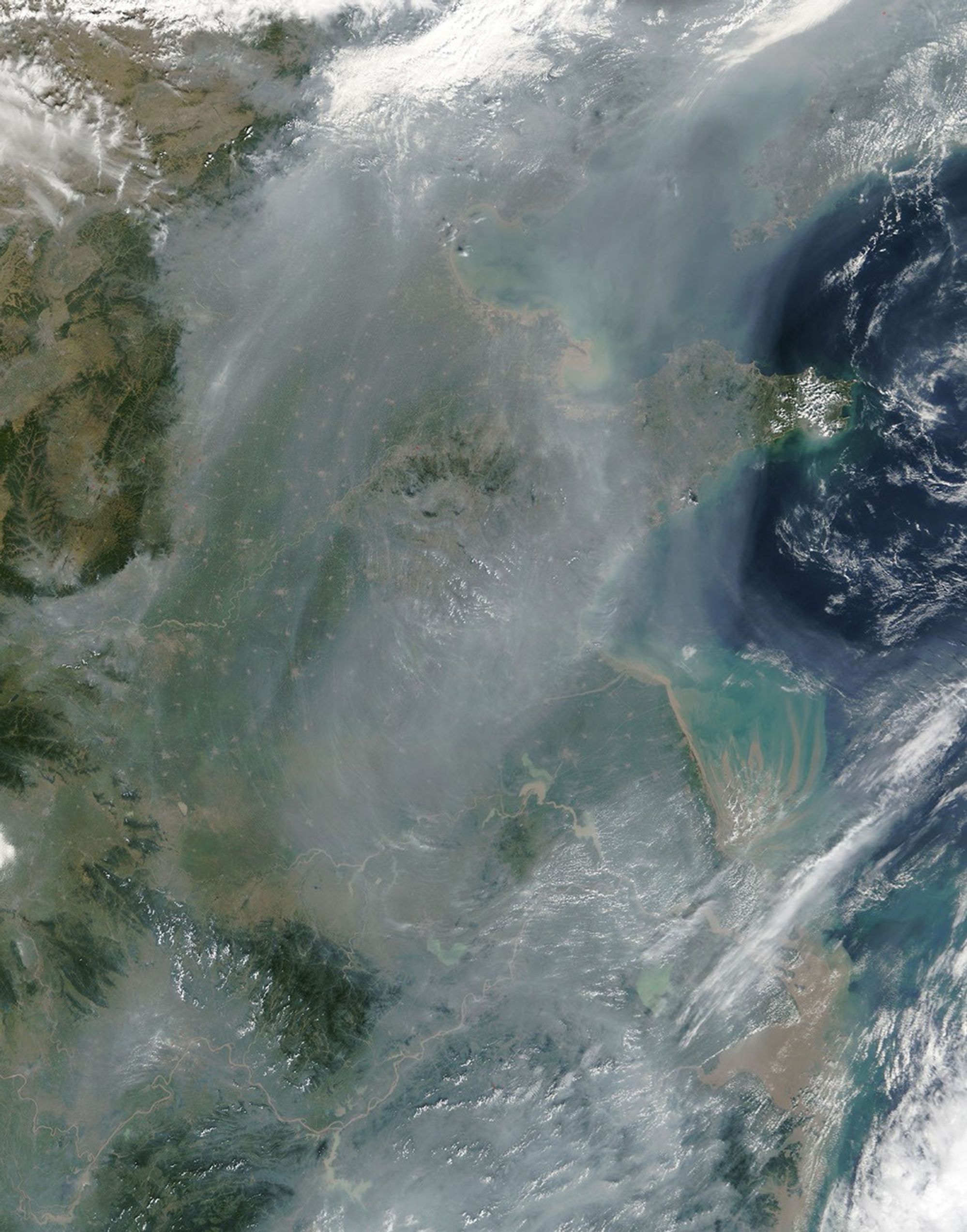
















A huge, thick cloud of haze hung over eastern China in early September 2005. The Moderate Resolution Imaging Spectroradiometer (MODIS) flying onboard the Terra satellite captured this image on September 10, 2005. In this image, haze covers China from the coastline in the east to the mountains in the west. The mountains actually play a role in trapping haze and smog. Weather patterns also play a role. When air is cooler near the ground and warmer higher up in the atmosphere, haze accumulates in the region.
China’s industrialization and urban growth contribute to the region’s air quality problems. A megacity is an urban center with 10 million or more inhabitants. Two of Earth’s 20 most populous cities—Shanghai with 12.8 million inhabitants, and Beijing with 10.8 million inhabitants—are in eastern China. Even outside these major cities, smaller urban areas dot the landscape, appearing in this image as little beige splotches.
This image also shows thick sediment along China’s coast, pushed toward the ocean by the country’s network of rivers.
- Recommended Further Reading:
- Cyranoski, D. (2005) Satellite View Alerts China to Soaring Pollution. Nature (437) 12.
- Marshall, J. (2005) Megacity, Mega Mess. Nature (437) 312-314.
References & Resources
NASA image courtesy Jeff Schmaltz, MODIS Land Rapid Response Team at NASA GSFC