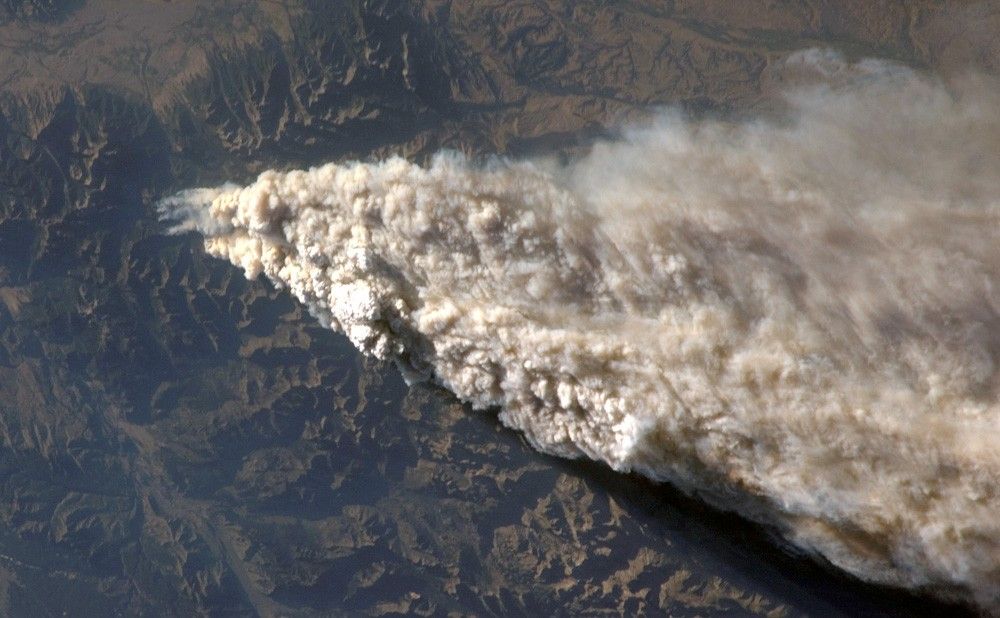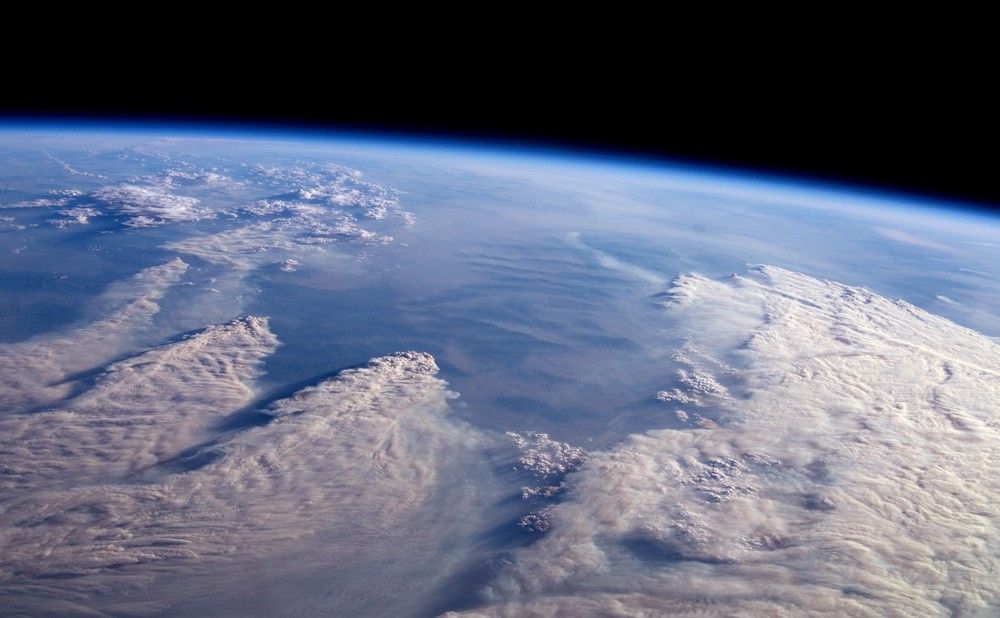














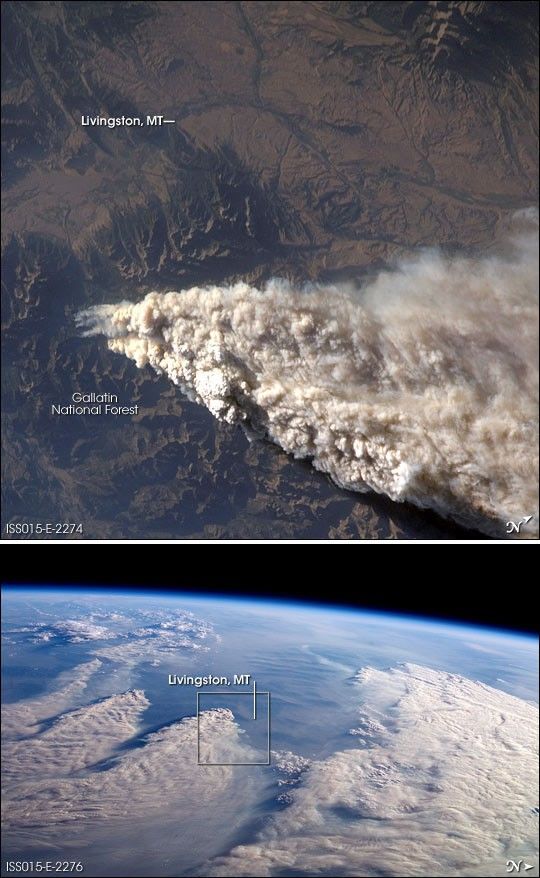
On August 13, 2007, while docked to the International Space Station (ISS), the crew members of Shuttle Mission STS-118 and ISS Expedition 15 reported seeing the smoke plumes from wide-spread fires across Idaho and Montana. The crew photographed and downlinked images of isolated plumes (top image) and regional views of the smoke (bottom image) from different perspectives. Strong westerly winds were driving the smoke eastward.
The close-up view shows the WH Complex Fire in southern Montana, which was burning in Gallatin National Forest. As of Friday, August 17, the National Interagency Fire Center estimated its size as 25,400 acres, and it was only 5 percent contained. The rugged topography that makes firefighting in the area so difficult is highlighted by shadows created by the oblique (from the side) perspective from which the astronauts took the photo. The plume has topography of its own, some plumes towering above others, casting dark shadows.
The regional view was taken looking westward toward the horizon. It shows fires not only in Montana, but also fires to the south in Wyoming, and to the northwest in Idaho. South (to the left) of the WH Complex Fire are the Columbine 1 Fire in Yellowstone National Park (18,500 acres and 0 percent contained), and the Hardscrabble Fire in Bridger-Teton National Forest (3,074 acres and 40 percent contained).
An even broader regional view of the extent of the fires was captured by the Moderate Resolution Imaging Spectroradiometer (MODIS) sensor onboard NASA’s Aqua satellite on August 12, 2007, the day before these images were taken by astronauts onboard the ISS.
References & Resources
Featured astronaut photographs ISS015-E-22274 and ISS015-E-22276 were acquired by the ISS 15 crew on August 13, 2007, with a Nikon D2X digital camera using a 24–120 mm lens at 95 and 40 mm focal length respectively. They are provided by the ISS Crew Earth Observations experiment and the Image Science & Analysis Laboratory, Johnson Space Center. The image in this article has been cropped and enhanced to improve contrast. The International Space Station Program supports the laboratory to help astronauts take pictures of Earth that will be of the greatest value to scientists and the public, and to make those images freely available on the Internet. Additional images taken by astronauts and cosmonauts can be viewed at the NASA/JSC Gateway to Astronaut Photography of Earth.