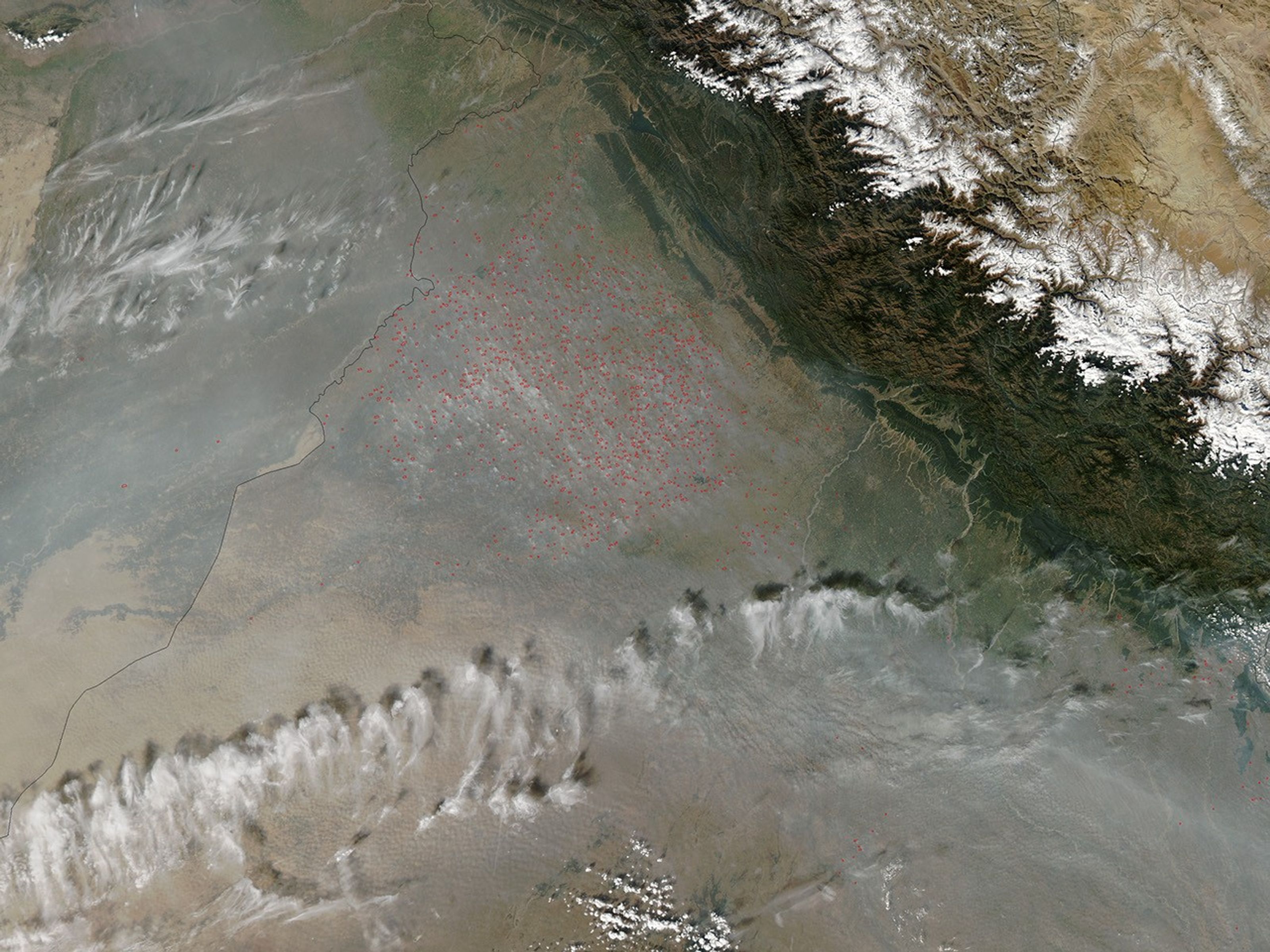

















The Indian state of Punjab has two growing seasons: one from May to September and another from November to April. Many farmers rotate between crops, planting rice in May and wheat in November. In order to quickly prepare their fields for the wheat crop, many farmers simply burn leftover plant debris after harvesting rice. The practice is known as paddy stubble burning.
Every year, Punjab rice farms collectively burn about 7 to 8 million metric tons of leftover plant debris in October and November. When the Moderate Resolution Imaging Spectroradiometer (MODIS) on NASA’s Aqua satellite passed over Punjab on October 30, 2014, numerous fires were burning. Red outlines show the approximate locations of active burning.
References & Resources
- Hindustan Times (2014, October 31) Paddy stubble burning: Two farmers booked in Sangrur. Accessed November 5, 2014.
- Kaur, R. et al, (2013) Practice of burning of crop residue: farmer’s perspective. Environment and Ecology, 31 (3), 1360-1363.
- Kumar, P. & Joshi, L. (2013, July 10) Pollution Caused by Agricultural Waste Burning and Possible Alternate Uses of Crop Stubble: A Case Study of Punjab. (Springer Berlin Heidelberg: New York)
- NASA Earth Observatory (2013, November 12) Stubble Burning in Northern India. Accessed November 5, 2014.
- The Pioneer (2014, October 31) Paddy stubble burning leading to health issues, pollution: Agri experts. Accessed November 5, 2014.
NASA image courtesy Jeff Schmaltz, LANCE MODIS Rapid Response Team at NASA GSFC. Caption by Adam Voiland.