
















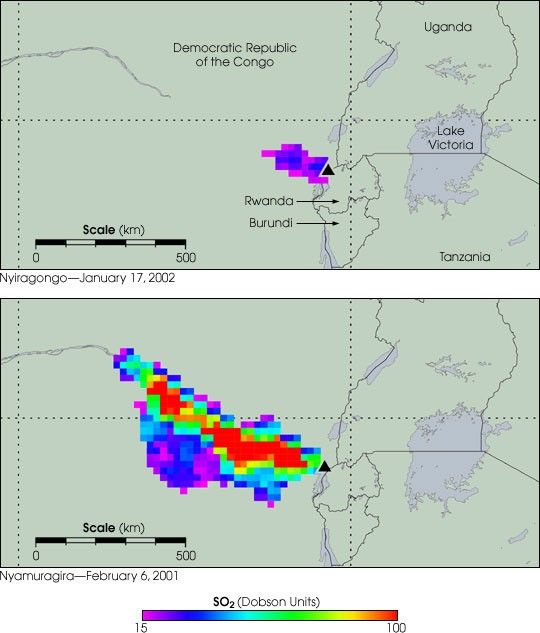
The Earth Probe Total Ozone Mapping Spectrometer (TOMS) detected a sulfurdioxide cloud associated with the January 2002 eruption of Nyiragongoas it flew over the region at around 11 a.m. local time (0900 UTC) on January17. The sensor detected no significant amounts of ash in the eruptioncloud. At the time of the TOMS overpass the cloud extended up to roughly 200 km(124 miles) northwest of Nyiragongo and was still attached to the volcano. Thisobservation is consistent with nearly coincident MODIS imagerywhich shows an opaque cloud of gas and steam in the same location. The TOMSmeasurements show that the amount of sulfur dioxide in the Nyiragongo’s plumerange from about 10 to 30 kilotons.
Please note that TOMS mass retrievals are dependent on the altitude of the cloudand may be adjusted as more information becomes available. Since the cloud maystill have been developing at the time of the TOMS overpass, the final sulfurdioxide burden may have been greater. Wind trajectory data (courtesy of LeslieLait, SSAI) suggest that part of the cloud may have reached at least mid- toupper-tropospheric altitudes of up to 12 km (7 miles), but scientists suspect nosignificant stratospheric injection of sulfur dioxide as a result of this eruptionsince the gas was not visible over the Democratic Republic of the Congo regionin subsequent TOMS data acquired on January 18.
Production of sulfur dioxide without a significant ash cloud is commonlyobserved during effusive eruptions such as the Nyiragongo event. Although denselow-level ash may be produced during such eruptions, these particulates usuallyfall out fairly quickly and elude detection by satellite. The size of the January 17Nyiragongo cloud and the estimated sulfur dioxide tonnage are fairly modest, and atleast an order of magnitude smaller than values typically measured by TOMSduring eruptions of nearby Nyamuragira during its frequent outbursts (e.g.,on February 6, 2001). Sulfur dioxide column amounts (measured in Dobson Units) are much higher in the more extensiveNyamuragira cloud, which contained roughly 420 kilotons of sulfur dioxide. Althoughseveral factors could affect the size of the observed cloud in each case—suchas the delay between the onset of the eruption and the TOMS overpass, and thevolume of lava emitted and the lava composition—the TOMS data suggest thatthe Nyiragongo magma may have been largely degassed before eruption. One possiblemechanism by which this could be achieved is the cyclic degassing of magma in thesubaerial lava lakes that have been intermittently present in Nyiragongo’s summitcrater over the past few decades.
References & Resources
Images courtesy Simon Cairn, TOMS Volcanic Emissions Group , Joint Center for Earth Systems Technology , University of Maryland-Baltimore County