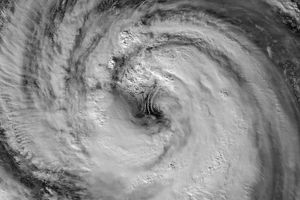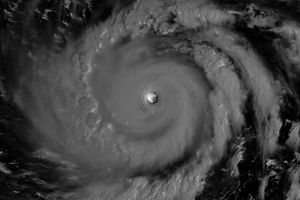
























Typhoon Chanchu first formed as a tropical storm in the western Pacific on May 8, 2006, roughly 500 miles east of the Philippines. The storm gradually built strength and size, reaching typhoon strength on May 11. It lost some power as it crossed the Philippines, but once clear of the islands, it regained strength and developed powerful winds and a large cyclonic structure as it continued on a northwesterly track across the South China Sea towards Hong Kong and mainland China.
This photo-like image was acquired by the Moderate Resolution Imaging Spectroradiometer (MODIS) on the Terra satellite on May 17, 2006, at 11:15 a.m. local time (03:15 UTC). The typhoon has a huge spiral-arm structure in this image and a well-defined cyclone shape, with a distinct, but cloud-covered eye (sometimes known as a “closed eye”) in the center. Sustained winds in the storm system were estimated to be around 185 kilometers per hour (115 miles per hour) around the time the image was captured, according to the University of Hawaii’s Tropical Storm Information Center.
The high-resolution image provided above is provided at the full MODIS spatial resolution (level of detail) of 250 meters per pixel. The MODIS Rapid Response System provides this image at additional resolutions.
References & Resources
NASA image by Jeff Schmaltz, MODIS Rapid Response Team, Goddard Space Flight Center.